
Timing the market is hard, and most people who try it get it wrong. Dollar cost averaging is the strategy built for everyone who would rather not gamble on the perfect entry. It gives you a systematic way to invest without the pressure of buying at exactly the right moment.
How Does Dollar Cost Averaging Work?
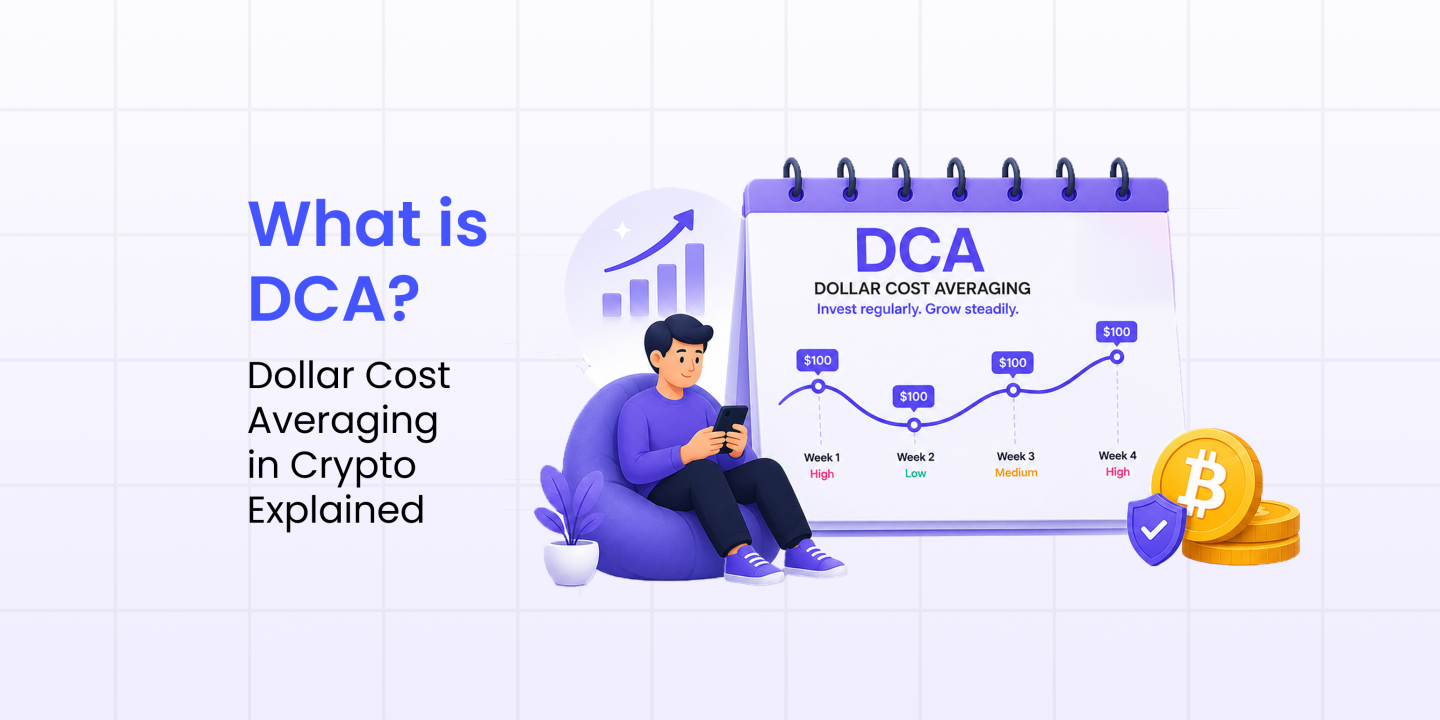
So how does dollar cost averaging work in practice? You split your total capital into smaller, equal portions and invest those portions at fixed intervals. The price on any given day doesn’t change your plan. You buy regardless.
The result is simple. When prices fall, your fixed amount buys more units. When prices rise, it buys fewer. Over time, this pulls your average cost per unit down and softens the impact of short-term swings on your portfolio.
Regular Investment Strategy
This is where understanding what is dollar cost averaging really starts: it’s about time in the market, not timing the market. You commit to a schedule, whether that’s a daily allocation or a monthly deposit, and you stick to it. The schedule does the deciding for you, so the usual hesitation around buying into a dip disappears.
Market Price Averaging
The dollar cost averaging meaning comes down to one thing: price aggregation. Buy an asset at lots of different price points and your total cost averages out. That’s what protects you from the worst-case scenario, sinking a large sum into the market right before it crashes.
Benefits of Dollar Cost Averaging in Crypto
Ask what does DCA mean in crypto and the answer reveals some real advantages. Digital assets move fast, which makes a single large lump-sum bet risky. A systematic approach shields you from that unpredictability and fits naturally with markets that trade around the clock.
The benefits stack up:
- It strips out the stress of guessing market tops and bottoms.
- It cushions you against crypto volatility, those sharp, unpredictable price swings that come out of nowhere.
- You avoid the trap of dumping all your capital at a local peak.
- It builds discipline because the investing happens on a schedule rather than on a whim.
Trading crypto-INR perpetual futures on Pi42 adds more on top. Perpetual futures are agreements to trade an asset later with no expiry date, and on Pi42, you trade them without the one percent TDS. You also skip the 30 percent VDA tax that the Income Tax Act 2025/2026 applies to virtual digital assets.
There’s another edge too. Pi42 lets you set off your losses, so you can manage what you owe while running a long-term strategy. Pair that tax treatment with consistent buying, and you have a strong setup for building wealth.
Risks and Limitations of DCA Strategy
The approach works, but it isn’t flawless. In a long bull run, dollar cost averaging tends to trail lump-sum investing. Holding capital back means you miss gains while the price keeps climbing.
It also won’t promise you a profit or save you from a market that declines over the long haul. Keep buying an asset that’s fundamentally rotting, and you’ll still lose money. That’s why the homework matters. Do the fundamental analysis before you lock into any long-term buying schedule.
How to Use DCA in Crypto Trading
New investors often ask what is DCA in trading and how to actually do it. Start with a budget that matches your goals. Settle on an amount you can put in regularly without squeezing the money you need for everyday life.
With the budget set, a platform like Pi42 handles the execution. It offers a secure environment with up to 20 times leverage, meaning you can borrow funds to size up a position and widen your market exposure while you build steadily.
Setting Investment Frequency
Picking a schedule is one of the first things to sort out in crypto trading for beginners. Most people go daily, weekly, or monthly, usually matching their income. A monthly cadence lines up with payday, which makes it easy to keep going without feeling the pinch.
Shorter intervals track the market more closely and catch more of its small movements. The catch is fees. If your platform charges a lot per trade, frequent small buys can eat into what you’re saving.
Choosing the Right Assets
The assets you pick decide whether the strategy holds up. Stick to established projects with real fundamentals and genuine utility. Obscure, speculative tokens carry far too much risk for a plan meant to accumulate quietly over years.
DCA vs Lump Sum Investing
People constantly weigh systematic buying against going all in at once. Lump-sum investing means committing your whole pot in a single transaction. It pays off handsomely if the market climbs straight after you buy.
The risk is buying at a local top. One correction and the portfolio drops into a painful loss overnight. Spreading the money out over time makes for a smoother, calmer ride.
Which one fits depends on your appetite for risk. The core differences:
- Lump-sum needs you to time the market, while systematic buying ignores the daily moves.
- Systematic buying curbs the panic trades that lump-sum investing tends to trigger when prices fall.
- Lump-sum wins in a clean bull run. Averaging earns its keep when the market turns choppy.
Who Should Use Dollar Cost Averaging?
This suits anyone who wants in on the market without watching it all day. If you’ve got a regular income and want to put some of it into digital assets, it fits. Busy professionals especially find it manageable.
DCA: Getting It Right
Get this strategy right, and you hold a real edge. Buying steadily lets you ride out the turbulence with discipline instead of nerves, and it stays one of the more dependable ways to build wealth over time while keeping emotional mistakes off the table.
Pi42 is India’s first crypto-INR perpetual futures platform, made for modern traders. You get structural perks like one percent TDS and the option to set off losses.
FAQ – Dollar Cost Averaging (DCA) in Crypto
1. What is DCA in crypto?
DCA, or Dollar Cost Averaging, is an investment strategy where you invest a fixed amount in cryptocurrency at regular intervals, regardless of market price.
2. How does Dollar Cost Averaging work?
DCA works by spreading your investment across multiple purchases over time. This helps reduce the impact of market volatility and averages out your buying cost.
3. Is DCA a good strategy for beginners?
Yes. DCA is beginner-friendly because it removes the need to time the market and encourages consistent investing habits.
4. What are the benefits of Dollar Cost Averaging?
DCA helps manage risk, reduces emotional decision-making, smooths out price fluctuations, and promotes long-term investing discipline.
5. Which cryptocurrencies are best for DCA?
Many investors prefer established cryptocurrencies with strong fundamentals, such as Bitcoin and Ethereum, for long-term DCA strategies.
6. What is the difference between DCA and lump-sum investing?
DCA spreads investments over time, while lump-sum investing puts all capital into the market at once. DCA reduces timing risk, whereas lump-sum investing can generate higher returns in a strong bull market.
7. Can DCA guarantee profits in crypto?
No. DCA helps reduce the impact of volatility, but it cannot guarantee profits or protect against losses if an asset declines over the long term.

Sarvesh Pandey is a growth marketing professional at pi42, where he leads digital acquisition, partnerships, and user growth initiatives in India’s evolving crypto ecosystem. With experience across fintech, EdTech, and consumer internet brands, he shares insights on crypto adoption, trading trends, and performance-led growth strategies.
- Pi42 Tick Together: Refer and Win an Armani Watch ⌚
 Pi42 Tick Together is a festive-season referral contest where your… Read more: Pi42 Tick Together: Refer and Win an Armani Watch ⌚
 - Pi42 Delisting: 74 USDT Futures Contracts on 29 October 2026
 As part of our periodic Market Quality Review, Pi42 is… Read more: Pi42 Delisting: 74 USDT Futures Contracts on 29 October 2026
 - Pi42 Head to Trade: Trade & Win the Season’s Biggest Prizes 🎮
 Pi42 Head to Trade is a festive-season trading contest where… Read more: Pi42 Head to Trade: Trade & Win the Season’s Biggest Prizes 🎮
 - Pi42 Snap Fiesta: Refer and Win an Instax Camera This October 📸
 Pi42 Snap Fiesta is an October referral contest that turns… Read more: Pi42 Snap Fiesta: Refer and Win an Instax Camera This October 📸
 - Pi42 BIG TAG: Refer and Win Nothing Buds This September
 Pi42 BIG TAG is a September referral contest that turns… Read more: Pi42 BIG TAG: Refer and Win Nothing Buds This September