
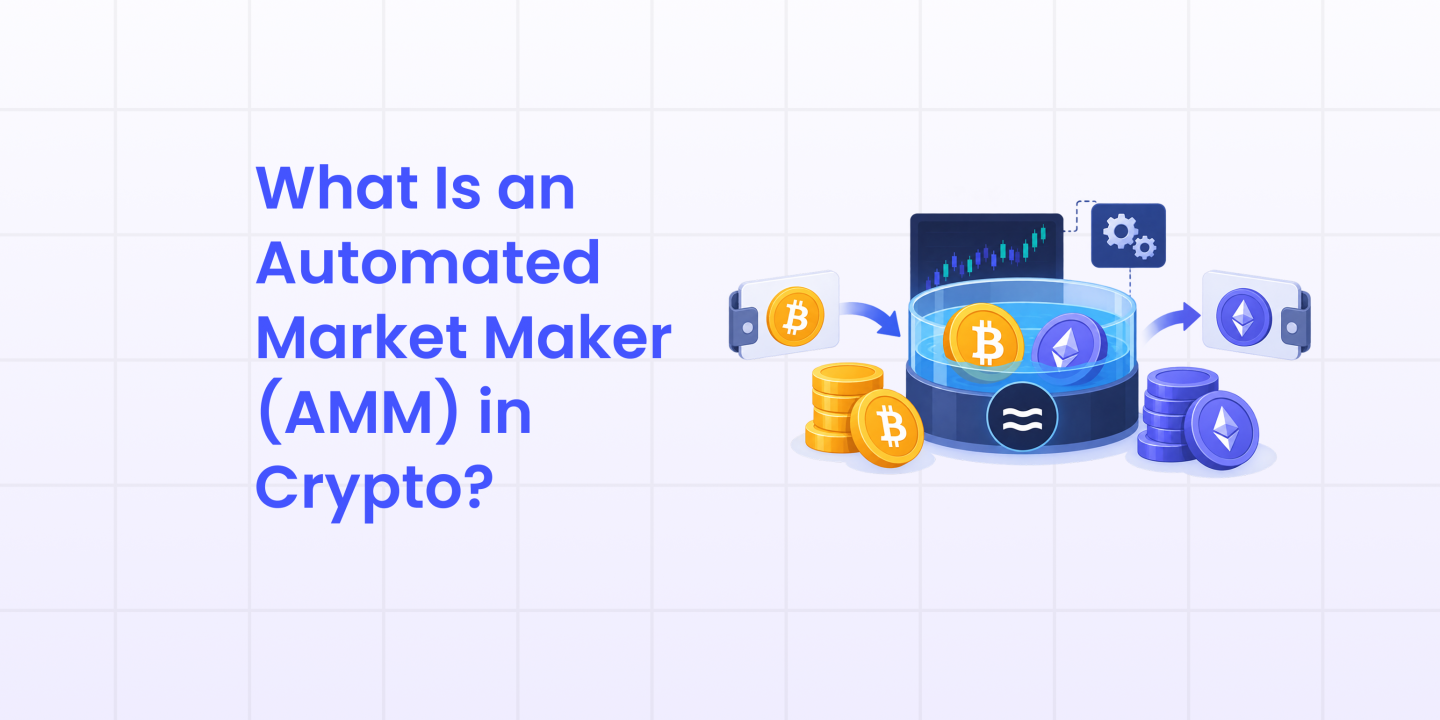
If you have ever traded on a decentralised exchange, you have likely used an automated market maker without realising it. So, what is AMM in crypto? An automated market maker (a system that prices and settles trades using mathematical formulas rather than human intermediaries) is an innovation in decentralised finance. To understand what an automated market maker is, picture a self-operating exchange that never sleeps, never needs a counterparty waiting on the other side, and runs entirely on code built atop blockchain technology.
Traditional exchanges rely on order books that match individual buyers with sellers. An automated market maker removes this matching process entirely, allowing trades to execute against a shared pool of funds instead.
How Do AMMs Work?
The question of how AMMs work centres on two ideas: liquidity pools and pricing formulas. Liquidity providers deposit pairs of tokens into a pool. Traders swap against that reserve. A mathematical formula determines the price as the ratio of assets shifts with each trade.
The most common model uses the constant product formula. It is expressed as x multiplied by y equals k. Here is how it functions:
- The variables x and y represent the quantities of two tokens in the pool.
- The value k remains constant. So buying one token raises its price as supply falls.
- Liquidity providers earn a share of trading fees in return for funding the pool.
This design means understanding what AMM is; crypto really comes down to grasping that algorithms, not people, set the prices.
Benefits of Automated Market Makers
Knowing what automated market maker technology is highlights several clear advantages:
- Markets stay open continuously, with no reliance on traditional buyers or sellers.
- Anyone can become a liquidity provider and earn passive income through fees.
- Smaller or newer tokens gain access to liquidity that order books rarely provide.
Risks of Using AMMs
Every innovation carries trade-offs. Traders and liquidity providers should remain aware of the following:
- Impermanent loss can reduce returns when token prices diverge significantly.
- Smart contract vulnerabilities may expose pooled funds to exploits.
- Low liquidity can cause slippage and heighten exposure to crypto liquidation in connected markets.
Key Takeaway
Automated market makers have reshaped how digital assets are traded, replacing intermediaries with transparent, self-executing code. For traders exploring decentralised finance, platforms such as Pi42 offer a strong starting point for building the needed knowledge.
FAQ – Automated Market Maker (AMM)
1. Why are automated market makers important in DeFi?
AMMs enable users to trade cryptocurrencies directly from liquidity pools without relying on traditional intermediaries, making decentralised trading more accessible.
2. Can anyone earn money from an AMM?
Yes. Users can become liquidity providers by depositing token pairs into a liquidity pool and earning a share of the trading fees generated by the platform.
3. What is impermanent loss in an AMM?
Impermanent loss occurs when the value of tokens deposited in a liquidity pool changes significantly compared to simply holding those assets.
4. Are AMMs safer than centralized exchanges?
AMMs eliminate the need for intermediaries, but they still carry risks such as smart contract vulnerabilities, liquidity issues, and market volatility.
5. Which popular platforms use automated market makers?
Many leading decentralized exchanges use AMM technology, including Uniswap, PancakeSwap, and Curve Finance.
6. Do I need a crypto wallet to use an AMM?
Yes. To trade through an AMM, you typically need a Web3 wallet that can connect to decentralized applications and exchanges.
7. How do AMMs make crypto trading more efficient?
AMMs provide continuous liquidity and automated pricing, allowing users to trade digital assets instantly without waiting for matching buy and sell orders.

Sarvesh Pandey is a growth marketing professional at pi42, where he leads digital acquisition, partnerships, and user growth initiatives in India’s evolving crypto ecosystem. With experience across fintech, EdTech, and consumer internet brands, he shares insights on crypto adoption, trading trends, and performance-led growth strategies.
- Pi42 Snap Fiesta: Refer and Win an Instax Camera This October 📸
 Pi42 Snap Fiesta is an October referral contest that turns… Read more: Pi42 Snap Fiesta: Refer and Win an Instax Camera This October 📸
 - Pi42 BIG TAG: Refer and Win Nothing Buds This September
 Pi42 BIG TAG is a September referral contest that turns… Read more: Pi42 BIG TAG: Refer and Win Nothing Buds This September
 - Leverage in Crypto Trading: Meaning, Benefits & Risks
 Few tools attract as much attention, or cause as much… Read more: Leverage in Crypto Trading: Meaning, Benefits & Risks
 - Big Loot September: Trade & Win a BMW Bike 🏍️
 Big Loot September is Pi42’s biggest reward drop of the… Read more: Big Loot September: Trade & Win a BMW Bike 🏍️
 - Pi42 Week of Wins: Trade & Win a New iPhone This September
 Pi42 Week of Wins is a September contest where every… Read more: Pi42 Week of Wins: Trade & Win a New iPhone This September