
The rise of crypto trading has handed investors a thicket of consensus mechanisms that keep decentralised networks honest. Before you touch any digital asset, it pays to know what runs underneath it. Most of that comes down to one split: proof of stake vs proof of work.
What is Proof of Work (POW)?
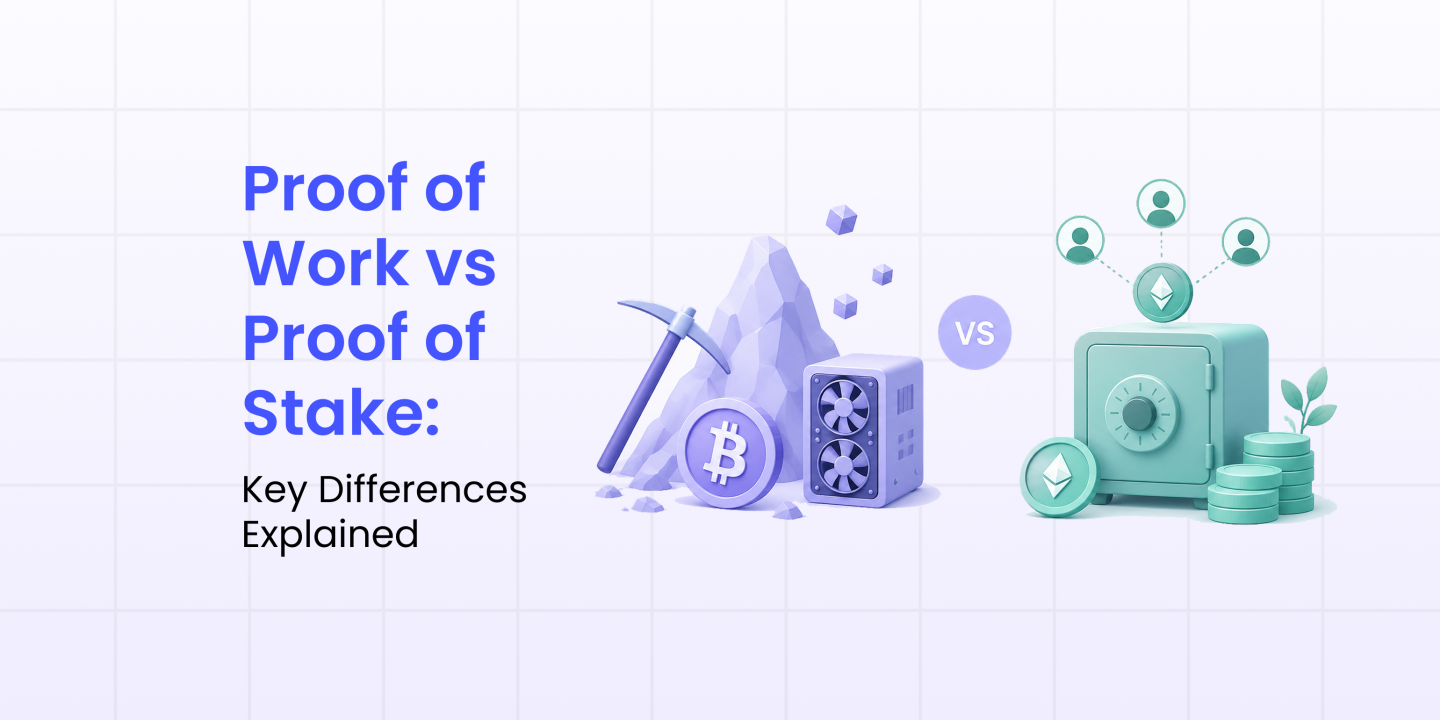
Proof of Work came first. It introduced the world to decentralised digital currency, and it leans on a simple but brutal idea: competition. Participants called miners throw computational POWer at cryptographic puzzles, racing to solve them.
How Proof of Work Works
Miners compete to validate each new block. The first to crack the solution broadcasts it, the rest of the network checks it, and once it clears, the block joins the chain. The winning miner walks away with a freshly minted coin.
That race burns POWer. It also demands specialised hardware, and the puzzles only get harder as the network grows, which pushes processing requirements higher still. The difficulty is the point. To rewrite the ledger, an attacker would need to control more than half the network’s computing POWer, an expense that rarely makes sense.
Here are the key characteristics of POW:
- It leans on heavy energy use to make attacks costly.
- It needs specialised hardware (Application-Specific Integrated Circuits) to mine competitively.
- It pays participants in newly created tokens.
Examples of POW Cryptocurrencies
Bitcoin is still the headline example. It set the standard for decentralised security and runs on this energy-hungry model to this day. Dogecoin and Litecoin follow the same path, using competitive mining to hold their networks together and keep user transactions safe.
What is Proof of Stake (POS)?
Proof of Stake arrived as an answer to two complaints about its predecessor: the energy bill and the scaling ceiling. Rather than burning electricity, it picks validators by how many coins they hold and are willing to lock up, or stake, as collateral.
How Proof of Stake Works
In the crypto proof of work vs proof of stake comparison, validators take the place of miners. The network picks one at random to build the next block, though holding more staked currency improves your odds. Misbehave and you lose your stake, so honesty is the profitable choice.
Validators check transactions, confirm activity, and propose blocks. When the network approves a block, the validator collects a transaction fee. No mining race means no enormous POWer draw, which is what makes staking the greener way to keep a chain running over the long haul.
Here are the essential aspects of POS:
It asks participants to lock up capital as collateral.
It drops the need for pricey mining hardware.
It uses a sliver of the energy older models burn.
Examples of POS Cryptocurrencies
Ether is the big one. It switched to POS specifically to run leaner. Solana and MATIC sit in the same camp, trading on this model to deliver quicker transactions and cheaper fees. All of them matter for modern digital finance and derivatives trading.
Difference Between Proof of Work and Proof of Stake
The crypto POS vs POW debate really comes down to how each system reaches agreement without a referee. Both protect the network. They just pick participants and spend resources in opPOSite ways, and those choices ripple out to sustainability, speed, and how far the network can scale.
- Energy Consumption
POW pulls huge amounts of electricity to keep mining hardware grinding around the clock. POS sips by comparison. It rests on locked capital instead of a computational arms race, which is a large part of why institutions and long-term holders find it easier to back.
- Security and Decentralisation
POW guards the network with raw computing POWer. Attacking it means buying mountains of hardware and electricity, and the math rarely adds up. POS guards the network with money on the line: attack it and your staked capital is forfeited. Both chase decentralisation. POS simply lowers the entry bar by ditching the hardware requirement.
- Transaction Speed and Scalability
Scalability is where POW vs POS gets interesting for developers. POW networks tend to slow down and grow expensive when traffic spikes. POS networks usually clear transactions faster and stretch further.
- Mining vs Staking
Mining is a treadmill. You keep buying hardware that loses value and paying energy bills that climb. Staking asks for capital upfront and not much after that. That shift, from depending on machines to depending on money, is the real fault line between the two dominant consensus mechanisms today.
Advantages and Limitations of POW vs POS
POW’s strongest card is its track record. It has protected Bitcoin for more than a decade without a major break. The downsides are familiar: it eats POWer, it runs slow, and the constant hardware upgrades quietly hand control to a few big operations sitting on cheap electricity.
POS flips the ledger. It is far more energy efficient and noticeably faster, which suits decentralised applications well. Its weak spot is concentration. The biggest holders can end up with outsized sway over the network.
Is Proof of Stake Better Than Proof of Work?
So, is proof of stake better than proof of work? It depends on the job. If you want a secure, tamper-proof store of value like Bitcoin, the energy-heavy model is still the gold standard. If you want a smart contract platform that moves fast and cheaply, staking has clearly pulled ahead.
Conclusion
For anyone digging into blockchain technology and digital assets, this groundwork matters. Learning where these systems diverge is the first real step toward trading responsibly.
For Indian investors, Pi42 stands as the first crypto-INR perpetual futures trading platform. It offers a secure environment to trade top assets with up to 20 times leverage (borrowed capital). Notably, Pi42 features no one percent Tax Deducted at Source (TDS) and no 30 percent Virtual Digital Asset (VDA) taxes, while allowing the set-off of losses.
By stripping away those tax burdens, Pi42 gives modern traders an efficient, capital-friendly place to work.
FAQ – Proof of Work vs Proof of Stake
1. Which is more environmentally friendly: Proof of Work or Proof of Stake?
Proof of Stake is generally considered more environmentally friendly because it requires significantly less energy than the mining process used in Proof of Work.
2. Can I earn rewards with Proof of Stake?
Yes. Users can earn staking rewards by locking up their cryptocurrency and helping validate transactions on a Proof of Stake network.
3. Why did some blockchains move from Proof of Work to Proof of Stake?
Many blockchains adopted Proof of Stake to improve energy efficiency, increase transaction speeds, and support greater network scalability.
4. Is Proof of Stake more secure than Proof of Work?
Both mechanisms are designed to secure blockchain networks. Proof of Work relies on computational power, while Proof of Stake relies on economic incentives and staked assets.
5. Do I need special equipment for Proof of Stake?
No. Unlike Proof of Work mining, Proof of Stake does not require expensive mining hardware. Users typically only need the required cryptocurrency to participate in staking.
6. Which cryptocurrencies use Proof of Stake?
Popular Proof of Stake cryptocurrencies include Ethereum, Solana, and Polygon.
7. Which is better for beginners: mining or staking?
Staking is often easier for beginners because it requires less technical knowledge, lower setup costs, and no specialized mining equipment.

Sarvesh Pandey is a growth marketing professional at pi42, where he leads digital acquisition, partnerships, and user growth initiatives in India’s evolving crypto ecosystem. With experience across fintech, EdTech, and consumer internet brands, he shares insights on crypto adoption, trading trends, and performance-led growth strategies.
- Pi42 Snap Fiesta: Refer and Win an Instax Camera This October 📸
 Pi42 Snap Fiesta is an October referral contest that turns… Read more: Pi42 Snap Fiesta: Refer and Win an Instax Camera This October 📸
 - Pi42 BIG TAG: Refer and Win Nothing Buds This September
 Pi42 BIG TAG is a September referral contest that turns… Read more: Pi42 BIG TAG: Refer and Win Nothing Buds This September
 - Leverage in Crypto Trading: Meaning, Benefits & Risks
 Few tools attract as much attention, or cause as much… Read more: Leverage in Crypto Trading: Meaning, Benefits & Risks
 - Big Loot September: Trade & Win a BMW Bike 🏍️
 Big Loot September is Pi42’s biggest reward drop of the… Read more: Big Loot September: Trade & Win a BMW Bike 🏍️
 - Pi42 Week of Wins: Trade & Win a New iPhone This September
 Pi42 Week of Wins is a September contest where every… Read more: Pi42 Week of Wins: Trade & Win a New iPhone This September