
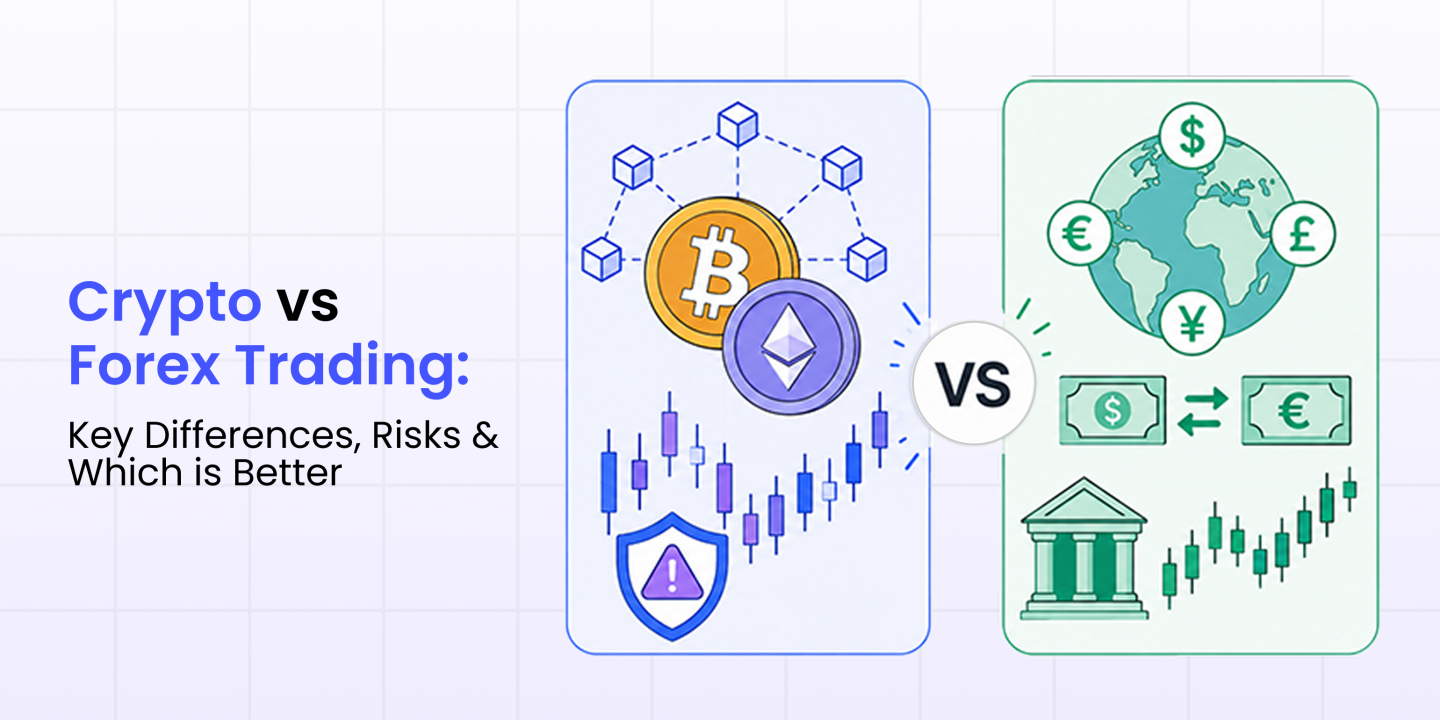
The modern investor’s radar is constantly pinging with the debate of crypto vs forex trading. Both arenas offer a distinct path to wealth, but they demand very different psychological profiles. While the foreign exchange market remains the veteran of global finance, the digital asset space has brought fresh energy to the table.
What is Forex Trading?
Forex is the act of swapping one national currency for another. It is a gargantuan market, boasting liquidity—the ease of converting an asset into cash without moving the needle on its price—that dwarfs every other financial sector. Here, you are trading the strength of nations through pairs like the GBP/USD or the USD/INR.
Retail traders share this space with central banks and massive institutional players who move billions in a single “lot” (the standard unit size of a trade). Success here often hinges on your ability to read the tea leaves of interest rate hikes, inflation reports, and geopolitical shifts.
What is Crypto Trading?
To understand this growing market, one must first address what is cryptocurrency? It is a digital asset built on the foundations of cryptography. So, it cannot be double-spent or faked. Unlike the traditional desks in London or New York, these assets live on a blockchain—a transparent, digital ledger that records every transaction across a network of computers.
The sheer variety of types of cryptocurrency can be staggering for the uninitiated. You have the “Blue Chips” like Bitcoin, utility tokens like Ether that act as gas for the Ethereum engine, and stablecoins, which are pegged to fiat currencies to provide a haven from price swings.
Forex vs Crypto: Key Differences
When you put forex vs crypto side-by-side, the operational differences are stark. It is the difference between a disciplined marathon and a 24-hour sprint that never reaches a finish line.
Market Hours
The forex world follows a strict, five-day work week. It rolls through the major sessions in London, New York, Tokyo, and Sydney, but it takes a breather on the weekends. Contrast this with the digital world, where cryptocurrency vs forex comparisons show a market that never sleeps. Crypto is a 24/7/365 machine. So, you can react to global news at any time without waiting for a Monday opening bell.
Volatility
Volatility is where these two truly diverge. Forex is the stable older sibling; it is rare to see a major currency move more than 1% in a day without a massive economic shock. However, forex trading vs crypto trading shows that in the crypto world, a 10% swing is just another Tuesday. This makes for high-stress, high-reward environments.
Liquidity
Forex is the undisputed heavyweight of liquidity. With over $7 trillion moving daily, you can enter and exit positions almost instantly without “slippage”—the gap between your requested price and the actual execution. While Bitcoin and Ether have deep pools of liquidity, smaller “altcoins” can be much thinner. Hence, it is harder to move large amounts of capital quickly without affecting the market price.
Regulation
Forex is a mature, tightly policed environment, overseen in India by the Reserve Bank of India. This offers a safety net that many institutional traders require. The crypto space, while maturing, is still a work in progress. India has made strides with FIU (Financial Intelligence Unit) registrations, but the landscape is still adapting to the unique challenges of decentralised finance.
Difference Between Forex Trading and Crypto Trading
The core difference between forex trading and crypto trading lies in what actually moves the price. In the forex pits, you are tracking the “fundamentals”—things like unemployment rates and central bank speeches. If the British economy looks shaky, the Pound will likely suffer too. It is a game of logic, history, and national policy.
Digital assets operate on a different frequency. The difference between forex and crypto is that the latter is often driven by “on-chain data” and social hype. A single software upgrade or a breakthrough in scaling technology can send prices to the moon. While forex traders use pips to measure profit, crypto traders are often looking for “multi-bagger” returns based on technological shifts.
Risks in Forex vs Crypto Trading
In forex, the biggest danger is often “leverage”—using borrowed money to amplify your trade size. It is a double-edged sword that can wipe out an account if the “pips” (the smallest price move in a currency) go the wrong way. In the digital asset space, the risks are often more technical. Beyond the price crashes, you have to worry about exchange security or “smart contract” bugs.
Crypto vs Forex for Beginners
For a newcomer, the choice is between structure and accessibility. Forex feels more like a traditional job; it has set hours and clear calendars. The ability to use “demo accounts” to practice with paper money is a massive advantage for those who want to learn without the sting of loss.
Yet, many young Indian investors are drawn to the low friction of crypto. You do not need a complex brokerage setup to start. Platforms like Pi42 have bridged the gap by allowing users to trade using Indian Rupees (INR). This removes the headache of managing currency conversions and lets beginners focus entirely on their trading strategy.
Which is Better: Forex or Crypto?
If you crave predictability and institutional security, forex is likely your best bet. It is a disciplined environment for those who enjoy the “macro” game and find comfort in the stability of major fiat currencies. But for those who want to be at the bleeding edge, the digital market is unparalleled. Traders are now using crypto options trading—contracts that give you the right to buy or sell at a specific price—to hedge their bets.
Creating A Growth Story
If you are ready to explore the high-growth world of crypto without the tax headaches, Pi42 is the answer. As India’s first crypto-INR perpetual futures platform, we provide a secure, FIU-compliant space to trade with up to 20x leverage.
FAQ’s – Crypto vs Forex
1) Which is better for beginners: crypto or forex trading?
Forex trading is generally considered more structured and stable, while crypto trading offers easier access and higher growth potential but comes with greater volatility.
2) What is the biggest difference between crypto and forex trading?
Forex trading focuses on national currencies influenced by economic factors, whereas crypto trading involves digital assets driven by blockchain adoption, market sentiment, and technology developments.
3) Is crypto trading riskier than forex trading?
Yes, crypto trading is typically riskier because of extreme volatility, 24/7 market movement, and less mature regulation compared to forex markets.
4) Can you trade crypto 24/7 unlike forex?
Yes, crypto markets operate continuously throughout the year, while forex markets usually close on weekends.
5) Which market is more profitable: crypto or forex?
Profitability depends on trading strategy and risk management, though crypto markets often offer higher return potential due to larger price swings.
6) Do crypto and forex trading both use leverage?
Yes, both markets offer leverage, allowing traders to control larger positions with smaller capital, but leverage also increases risk significantly.

Sarvesh Pandey is a growth marketing professional at pi42, where he leads digital acquisition, partnerships, and user growth initiatives in India’s evolving crypto ecosystem. With experience across fintech, EdTech, and consumer internet brands, he shares insights on crypto adoption, trading trends, and performance-led growth strategies.
- Pi42 Snap Fiesta: Refer and Win an Instax Camera This October 📸
 Pi42 Snap Fiesta is an October referral contest that turns… Read more: Pi42 Snap Fiesta: Refer and Win an Instax Camera This October 📸
 - Pi42 BIG TAG: Refer and Win Nothing Buds This September
 Pi42 BIG TAG is a September referral contest that turns… Read more: Pi42 BIG TAG: Refer and Win Nothing Buds This September
 - Leverage in Crypto Trading: Meaning, Benefits & Risks
 Few tools attract as much attention, or cause as much… Read more: Leverage in Crypto Trading: Meaning, Benefits & Risks
 - Big Loot September: Trade & Win a BMW Bike 🏍️
 Big Loot September is Pi42’s biggest reward drop of the… Read more: Big Loot September: Trade & Win a BMW Bike 🏍️
 - Pi42 Week of Wins: Trade & Win a New iPhone This September
 Pi42 Week of Wins is a September contest where every… Read more: Pi42 Week of Wins: Trade & Win a New iPhone This September