
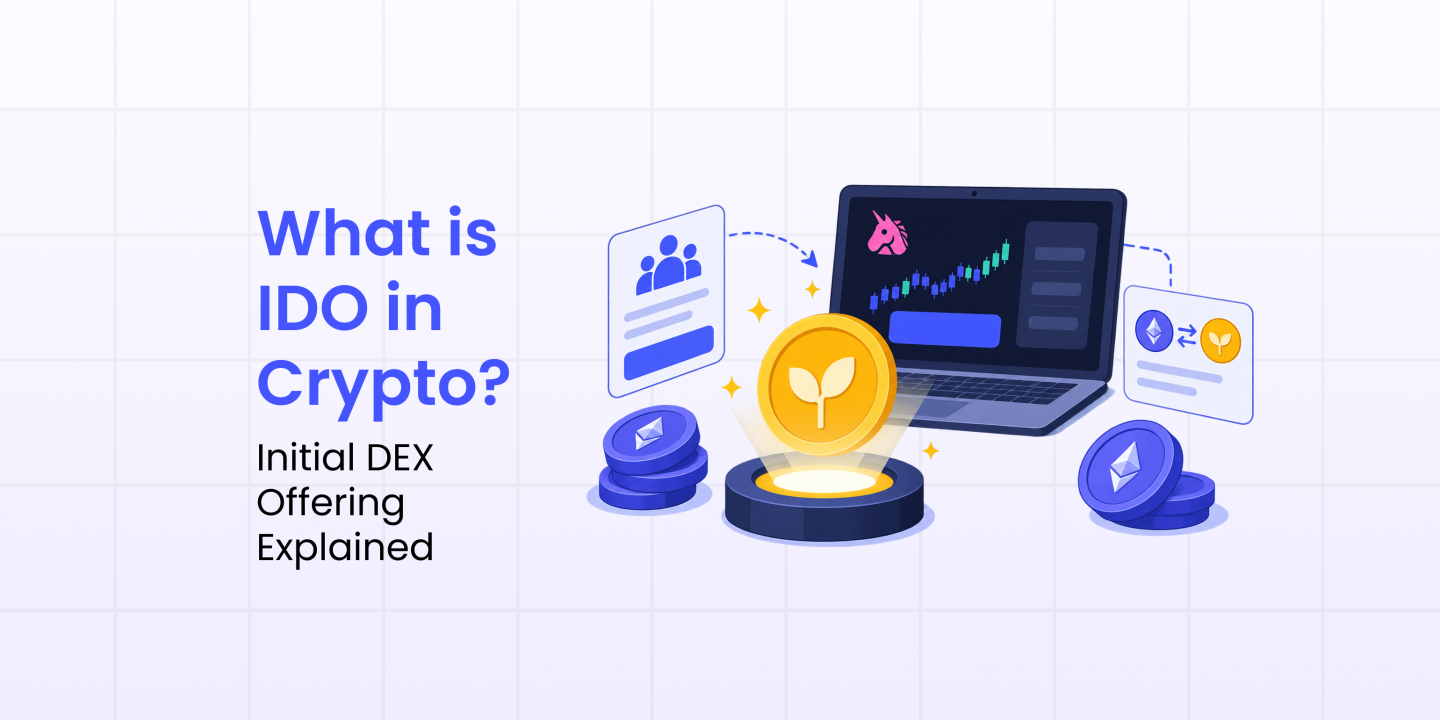
DeFi moves fast. New projects always need capital, and they keep inventing ways to get it. Understanding what is IDO in crypto matters for any trader who wants in on early-stage plays. So what is an initial DEX offering? It is a fundraising method, also called an IDO, where a project launches its token straight through a decentralized exchange (DEX).
How Does an IDO Work?
If you are still asking what is IDO in cryptocurrency, the mechanics make it clear. An IDO taps into a DEX’s liquidity instead of routing through a bank or broker. Here is the usual flow:
- Project Selection: The team picks a DEX to host the launch.
- Liquidity Provision: They seed a liquidity pool on the exchange, pairing the new token with an existing one.
- Token Sale: Buyers deposit funds into that pool and get tokens directly from the protocol.
- Trading: When the sale ends, the token trades right away.
IDO vs ICO vs IEO
What does IDO mean in crypto compared to what came before? All three raise money, but they run very differently:
- ICO (Initial Coin Offering): The team runs everything. You often have to trust them with funds before any token exists.
- IEO (Initial Exchange Offering): A centralized exchange vets the project and runs the sale as gatekeeper.
- IDO (Initial DEX Offering): Smart contracts handle it on a DEX. No middleman.
Sorting out these differences is a real starting point for crypto trading for beginners.
How to Participate in an IDO?
Joining an IDO takes a little setup:
- Set Up a Web3 Wallet: Get a non-custodial wallet like MetaMask to reach decentralized protocols.
- Acquire Funding: Hold the base token you will need, usually ETH or BNB.
- Connect to the DEX: Link your wallet to the platform running the IDO.
- Complete the Swap: Follow the prompts and swap your base tokens for the project tokens while the sale is open.
What are The Next Steps for Crypto Traders?
While these opportunities offer unique access to early-stage spot assets, they carry considerable volatility risks that require careful navigation.
To balance such risks, experienced traders often diversify into established markets using advanced hedging instruments. For those looking to evolve their strategies, Pi42 offers India’s first crypto-INR perpetual futures trading platform. We help you save 1% TDS (Tax Deducted at Source) and avoid the flat 30% VDA (Virtual Digital Asset).
FAQ – Initial DEX Offering (IDO)
1. Is an IDO worth investing in?
An IDO can offer early access to promising crypto projects, but it also carries significant risk. Always research the project’s team, utility, and tokenomics before investing.
2. Can beginners participate in an IDO?
Yes, beginners can participate in IDOs if they have a Web3 wallet and understand the basics of decentralized exchanges and crypto transactions.
3. How much money do I need to join an IDO?
The minimum investment varies by project and platform. Some IDOs allow participation with small amounts, while others may require higher allocations.
4. Why do crypto projects launch through IDOs?
Projects use IDOs to raise funds, build community support, and provide immediate token liquidity through decentralized exchanges.
5. Can I sell my tokens immediately after an IDO?
In most cases, yes. Once the token is listed on the DEX, participants can usually trade, hold, or sell their tokens based on market conditions.
6. How do I identify a legitimate IDO project?
Look for transparent teams, audited smart contracts, clear use cases, active communities, and detailed project documentation before investing.
7. What happens if an IDO project fails?
If a project fails to gain adoption or execute its roadmap, the token’s value may decline significantly, resulting in potential losses for investors.

Sarvesh Pandey is a growth marketing professional at pi42, where he leads digital acquisition, partnerships, and user growth initiatives in India’s evolving crypto ecosystem. With experience across fintech, EdTech, and consumer internet brands, he shares insights on crypto adoption, trading trends, and performance-led growth strategies.
- Big Loot September: Trade & Win a BMW Bike 🏍️
 Big Loot September is Pi42’s biggest reward drop of the… Read more: Big Loot September: Trade & Win a BMW Bike 🏍️
 - Pi42 Week of Wins: Trade & Win a New iPhone This September
 Pi42 Week of Wins is a September contest where every… Read more: Pi42 Week of Wins: Trade & Win a New iPhone This September
 - Chandi Utsav: Refer and Win Silver Coin
 This September, turn your referrals into something worth its weight!… Read more: Chandi Utsav: Refer and Win Silver Coin
 - Booked by Pi42: Amsterdam Awaits — Trade More, Travel More ✈️
 Booked by Pi42 is a trading contest that could send… Read more: Booked by Pi42: Amsterdam Awaits — Trade More, Travel More ✈️
 - Pi42 Bandhan Bonus: Win Amazon Gift Vouchers This Rakhi
 Pi42 Bandhan Bonus is a Rakhi referral contest where you… Read more: Pi42 Bandhan Bonus: Win Amazon Gift Vouchers This Rakhi