
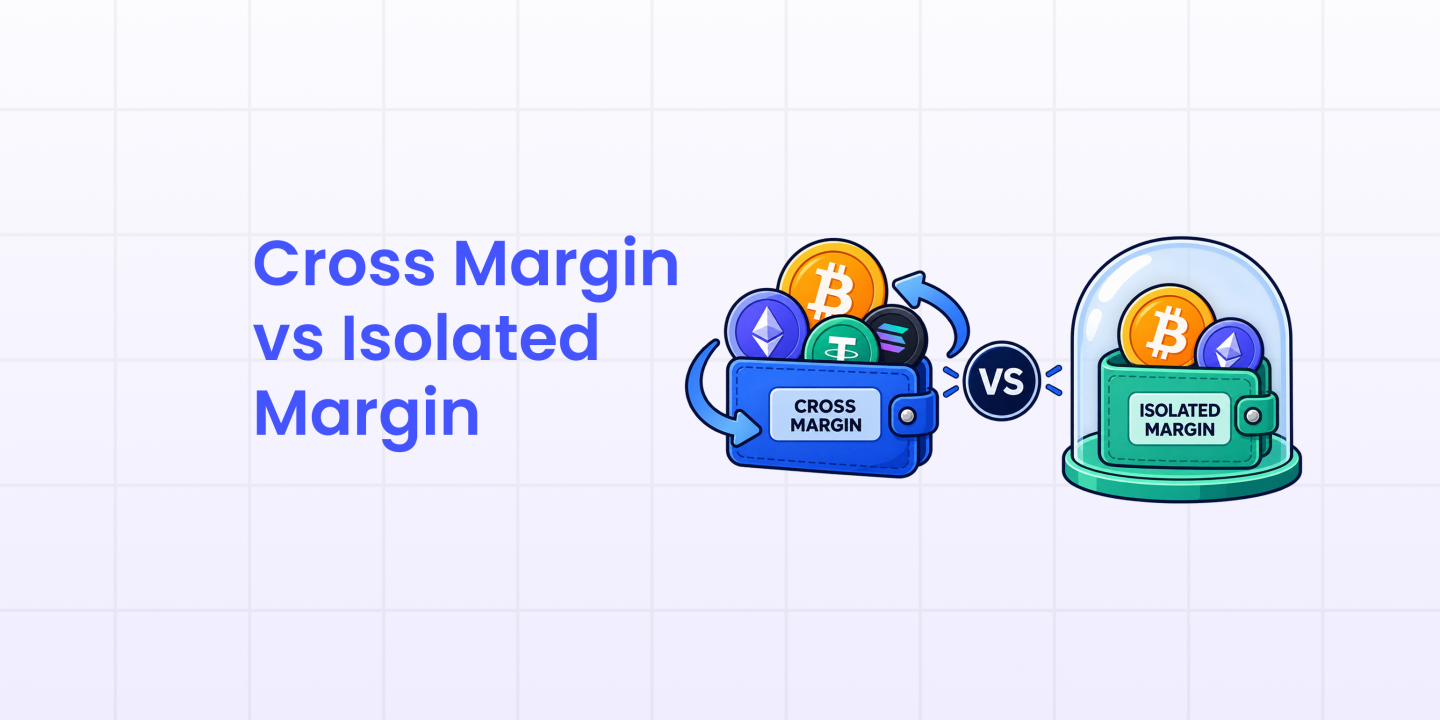
In crypto, leverage magnifies gains. However, it also accelerates losses exponentially. One single structural choice dictates your overarching risk exposure. This brings us directly to the pivotal debate of cross margin vs isolated margin.
What is a cross margin?
Here, your entire account balance acts as a shared collateral pool backing all open positions. Funds automatically shift to keep unprofitable trades afloat. This prevents premature crypto liquidation during sudden market dips. For active traders managing multiple overlapping positions, it offers a distinct operational advantage. Unrealised profits from a winning trade can directly offset a bleeding one. However, the stakes are undeniably high in this environment. A massive, unexpected market downturn could theoretically wipe out your entire wallet balance in seconds.
What is isolated margin?
This alternative setting takes a strict, compartmentalised approach to financial risk. You lock a specific amount of funds to a single trade. The rest of your wallet stays untouched. Market moving against you? Your maximum loss is capped exactly at that assigned collateral. You are essentially building a robust firewall around your individual trades. This extreme level of control appeals heavily to professionals executing high-risk contract trading strategies.
Difference Between Cross Margin and Isolated Margin
Evaluating the core difference between cross and isolated margin comes down to collateral distribution.
| Feature | Cross Margin | Isolated Margin |
| Risk Containment | Puts your entire unallocated wallet balance on the line. | Forcefully restricts losses to a single trade’s specific allocation. |
| Position Maintenance | Automatically shifts available balance to sustain floating losses. | Demands constant monitoring and manual capital injections to avoid closure. |
| Profit Sharing | Allows unrealised winning trades to openly subsidise losing ones. | Keeps all profits and losses strictly ring-fenced to the individual position. |
Comparing isolated margin vs cross-margin comes down to one critical choice. Do you want a shared portfolio safety net or highly secure individual life rafts?
Cross Margin vs Isolated Margin: Which is Better?
There is no universally superior choice in the cross vs isolated margin discussion. Your ideal mode depends entirely upon your broader strategic goals. Running multiple hedging strategies? Cross mode provides the operational fluidity you need, cutting out the headache of micromanaging margin levels. Prefer concentrated, high-conviction directional bets? The isolated approach is far safer. It ensures a single miscalculation does not empty your trading account. As one of the top crypto exchanges in India, Pi42 allows traders to rapidly adapt their margin modes to fit their immediate risk appetite. Ultimately, resolving the isolated vs cross-margin dilemma relies heavily on disciplined stop-loss placement.
Mastering Your Crypto Margin Strategy
Leverage in crypto derivatives operates as a powerful double-edged sword. Selecting the right collateral strategy dictates whether you survive a sudden, violent market swing. Cross mode offers incredible flexibility and automated survival for complex, diversified portfolios. On the other hand, the isolated framework ensures granular control over every single directional bet. Mastering this dynamic is utterly non-negotiable for serious traders today. Consider Pi42 today. Take absolute command of your trading risk.
FAQs
1. Can I switch between cross margin and isolated margin after opening a trade?
Some crypto trading platforms allow traders to switch margin modes for an existing position, while others require the trade to be closed first. Always check the platform’s rules before making changes, as switching may affect margin requirements.
2. Which margin mode is better for beginners?
Isolated margin is generally considered more suitable for beginners because it limits potential losses to the collateral assigned to a single position. This helps new traders manage risk more effectively while learning how leveraged trading works.
3. Does cross margin reduce the chances of liquidation?
Cross margin can reduce the likelihood of liquidation by using the available balance in your trading account to support open positions. However, if losses continue to grow, your entire account balance may still be at risk.
4. Can professional traders use both cross and isolated margin?
Yes. Many experienced traders use both modes depending on their strategy. They may choose cross margin for hedged or multiple positions and isolated margin for high-conviction trades where they want tighter risk control.
5. Does leverage work differently in cross-margin and isolated margin?
The leverage itself works similarly in both modes, but the way collateral is managed differs. Cross margin shares available funds across positions, while isolated margin limits collateral to a specific trade.
6. What factors should traders consider before choosing a margin mode?
Traders should evaluate their risk tolerance, trading experience, portfolio size, leverage level, and strategy before selecting a margin mode. Understanding how each mode manages collateral is essential for effective risk management.

Sarvesh Pandey is a growth marketing professional at pi42, where he leads digital acquisition, partnerships, and user growth initiatives in India’s evolving crypto ecosystem. With experience across fintech, EdTech, and consumer internet brands, he shares insights on crypto adoption, trading trends, and performance-led growth strategies.
- Big Loot September: Trade & Win a BMW Bike 🏍️
 Big Loot September is Pi42’s biggest reward drop of the… Read more: Big Loot September: Trade & Win a BMW Bike 🏍️
 - Pi42 Week of Wins: Trade & Win a New iPhone This September
 Pi42 Week of Wins is a September contest where every… Read more: Pi42 Week of Wins: Trade & Win a New iPhone This September
 - Chandi Utsav: Refer and Win Silver Coin
 This September, turn your referrals into something worth its weight!… Read more: Chandi Utsav: Refer and Win Silver Coin
 - Booked by Pi42: Amsterdam Awaits — Trade More, Travel More ✈️
 Booked by Pi42 is a trading contest that could send… Read more: Booked by Pi42: Amsterdam Awaits — Trade More, Travel More ✈️
 - Pi42 Bandhan Bonus: Win Amazon Gift Vouchers This Rakhi
 Pi42 Bandhan Bonus is a Rakhi referral contest where you… Read more: Pi42 Bandhan Bonus: Win Amazon Gift Vouchers This Rakhi