

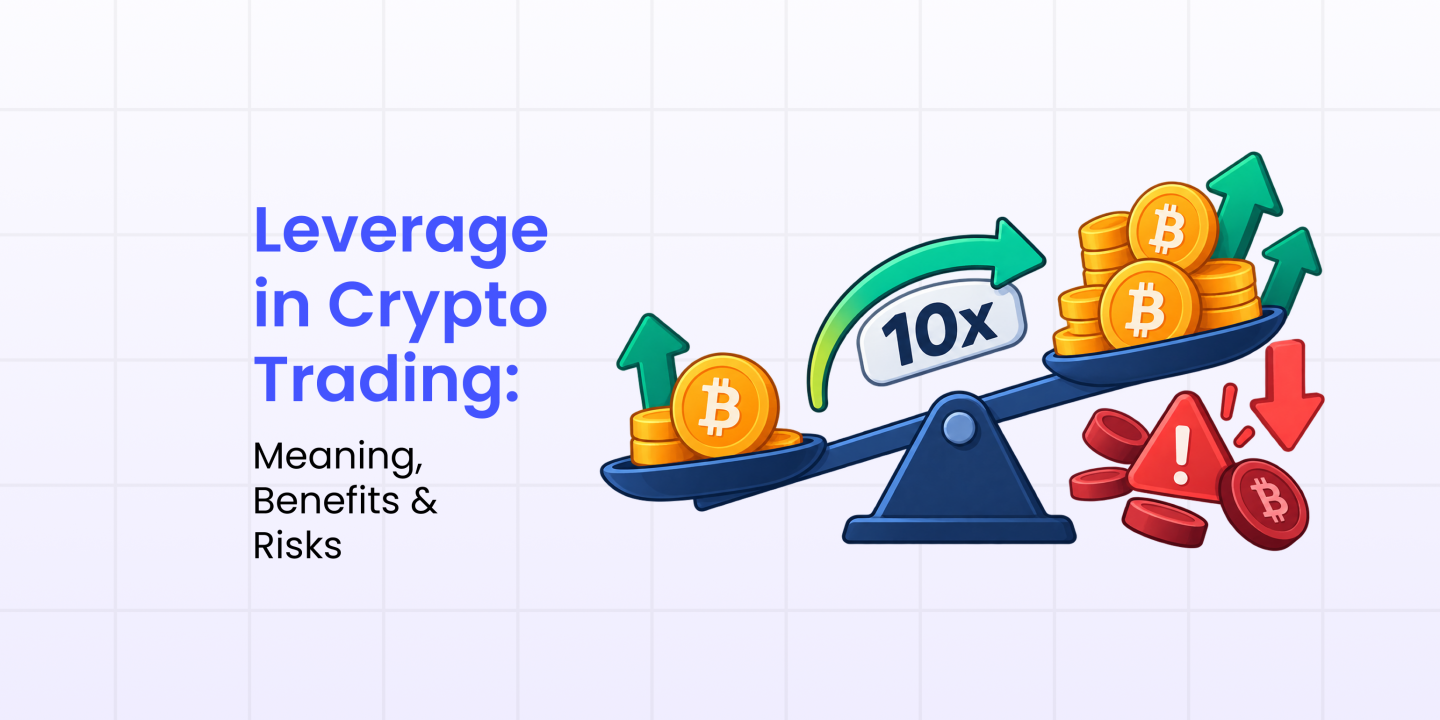
Few tools attract as much attention, or cause as much damage, as leverage in crypto trading. Applied with discipline, it improves capital efficiency. Applied carelessly, it turns ordinary volatility into a total loss.
What is Leverage in Cryptocurrency?
The leverage meaning in crypto trading is straightforward. A trader pledges a small amount of capital as collateral and gains exposure to a far larger position. Exchanges express this as a ratio, such as five times (5x) or 20 times (20x). At ten times (10x), collateral of ₹10,000 controls a position worth ₹1,00,000. Leverage in cryptocurrency multiplies exposure, not accuracy.
How Does Leverage Trading Work in Crypto?
Two mechanisms dominate. The first is crypto margin trading, where the trader borrows funds from the exchange. The second is perpetual futures, where leverage sits inside the contract.
Three terms govern every leveraged position:
- Initial margin: the collateral required to open the position.
- Maintenance margin: the minimum balance required to keep it open.
- Liquidation price: the level at which the exchange closes the position.
Collateral can be allocated in two ways. The cross margin vs isolated margin decision determines whether the whole account balance defends a position or only the amount assigned to it.
Benefits and Risks of Cryptocurrency Leverage
Traders adopt cryptocurrency leverage for reasons beyond larger returns:
- Capital efficiency: a smaller deposit frees capital for other trades.
- Two-way access: short positions profit from declining prices.
- Hedging: an existing spot holding can be protected without selling.
The risks scale just as quickly. The most immediate is crypto liquidation, which occurs when collateral can no longer cover the running loss and the exchange closes the position. At ten times (10x), a 10% adverse move triggers it. Two further risks matter:
- Funding costs: perpetual positions accrue funding fees, typically every eight hours, which compound over time.
- Round-the-clock markets: crypto never closes, so positions can be liquidated overnight or on weekends.
Leverage Trading Crypto for Beginners
Anyone approaching leverage trading crypto for beginners should treat the first months as survival practice rather than a route to returns. A conservative framework helps:
- Begin at two or three times leverage, far below the maximum offered.
- Place a stop-loss order before entering, not after the market moves against the position.
- Size positions by the rupee amount at risk, not by the leverage on offer.
- Keep spare margin as a buffer against volatility.
Platform choice matters. When assessing the best crypto futures trading platform, Indian traders should weigh settlement currency, tax treatment, and margin rules. Pi42, India’s first crypto-INR perpetual futures platform, settles trades in rupees, applies no 1% TDS or 30% VDA tax on futures, permits the set-off of losses, and offers leverage of up to 20 times.
The Bottom Line
Leverage rewards structure and punishes improvisation. Traders who understand margin mechanics, respect liquidation thresholds, and start small give themselves the time required to build genuine skill. Those who begin at maximum leverage rarely last long enough to develop it.
FAQs About Leverage in Crypto Trading
1) What does leverage mean in crypto trading?
Leverage allows traders to control a larger position with a smaller amount of capital. For example, 10x leverage lets ₹10,000 control a position worth ₹1,00,000.
2) Does higher leverage mean higher profits?
Higher leverage increases your potential profit because your market exposure is larger. However, it also increases potential losses and brings the liquidation price closer.
3) What happens when a leveraged crypto position is liquidated?
Liquidation occurs when your available collateral falls below the required level. The exchange may automatically close the position to prevent further losses.
4) What is the difference between cross margin and isolated margin?
With isolated margin, only the funds assigned to a position are at risk. Cross margin can use the wider available account balance to support an open position.
5) What leverage should a beginner use in crypto?
Beginners may consider starting with lower leverage, such as 2x or 3x, while learning how margin, liquidation and price movements affect their positions.
6) Can you lose more money with crypto leverage?
Leverage can cause losses to build much faster than in a spot trade. A sharp price movement against a leveraged position can consume the available margin and result in liquidation.

Sarvesh Pandey is a growth marketing professional at pi42, where he leads digital acquisition, partnerships, and user growth initiatives in India’s evolving crypto ecosystem. With experience across fintech, EdTech, and consumer internet brands, he shares insights on crypto adoption, trading trends, and performance-led growth strategies.
- Leverage in Crypto Trading: Meaning, Benefits & Risks
 Few tools attract as much attention, or cause as much… Read more: Leverage in Crypto Trading: Meaning, Benefits & Risks
 - Big Loot September: Trade & Win a BMW Bike 🏍️
 Big Loot September is Pi42’s biggest reward drop of the… Read more: Big Loot September: Trade & Win a BMW Bike 🏍️
 - Pi42 Week of Wins: Trade & Win a New iPhone This September
 Pi42 Week of Wins is a September contest where every… Read more: Pi42 Week of Wins: Trade & Win a New iPhone This September
 - Chandi Utsav: Refer and Win Silver Coin
 This September, turn your referrals into something worth its weight!… Read more: Chandi Utsav: Refer and Win Silver Coin
 - Booked by Pi42: Amsterdam Awaits — Trade More, Travel More ✈️
 Booked by Pi42 is a trading contest that could send… Read more: Booked by Pi42: Amsterdam Awaits — Trade More, Travel More ✈️