

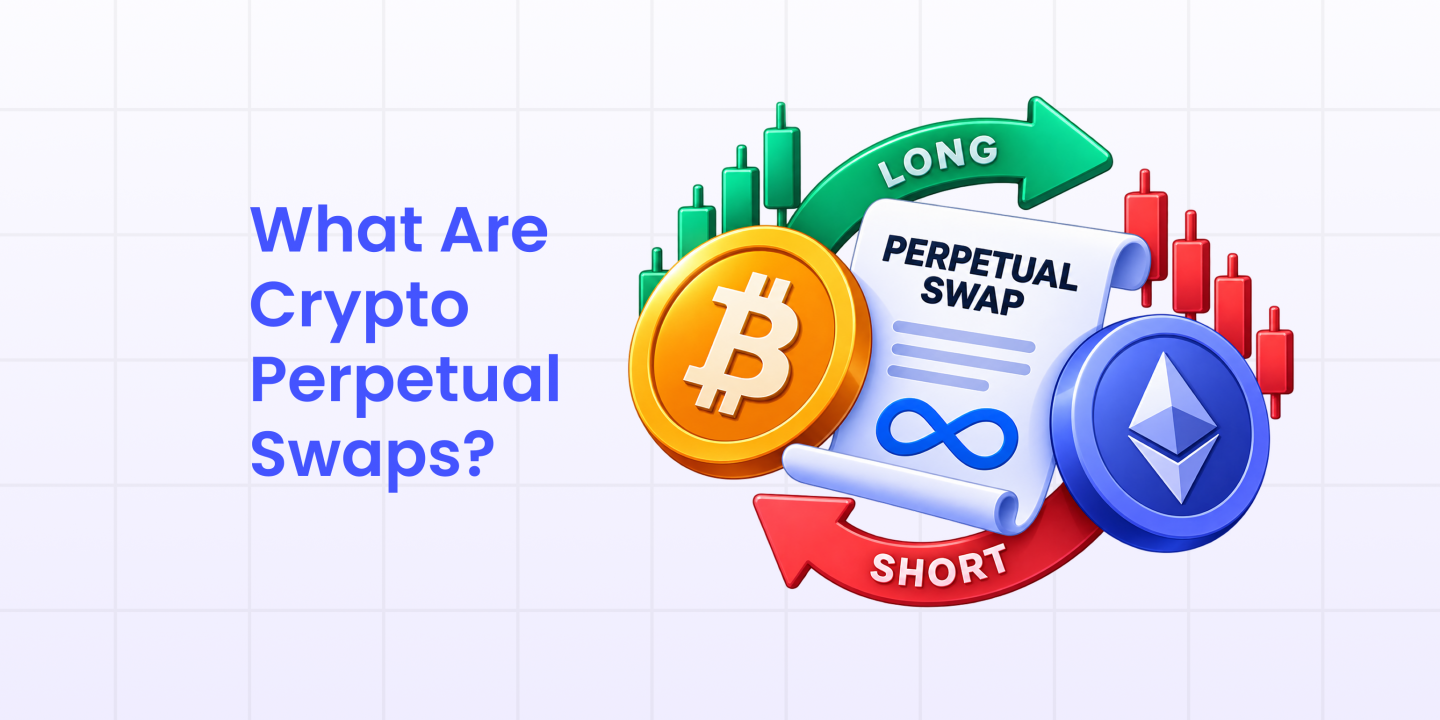
Crypto perpetual swaps are derivative contracts (agreements that draw their value from an underlying asset), allowing traders to speculate on the price of Bitcoin, Ether, Solana, MATIC or Ripple without owning the coins. Their defining trait is the absence of an expiry date.
That trait sits at the centre of the Perpetual Futures vs Quarterly Futures debate. Anyone asking what are perpetual swaps can picture a position that remains open until the trader closes it, or until the market closes it through liquidation.
How Do Perpetual Swaps Work?
Newer traders frequently search for the phrase “how do perpetual swaps work,” and the answer rests on three connected mechanisms.
- Margin: Traders deposit collateral to open a position. This deposit forms the basis of Crypto Margin Trading, where a modest sum controls a far larger exposure.
- Funding rate: A periodic payment exchanged directly between long and short holders. When the contract trades above the spot price, longs pay shorts. When it trades below, shorts pay longs.
- Liquidation: Should losses erode the margin below the maintenance requirement, the exchange closes the position automatically.
The funding rate deserves particular attention. A quarterly contract converges with spot because it must settle on a fixed date. A perpetual contract has no deadline, so funding is the only tether to the underlying market.
Key Features of Perpetual Swaps
Several features of perpetual swaps explain their dominance of global Crypto F&O Trading volumes.
- No expiry date, which removes the cost of rolling positions forward.
- Leverage of up to 20 times on Pi42, which magnifies gains and losses in equal measure.
- Liquidity that often exceeds the corresponding spot market, producing tighter spreads.
- Two-way exposure, enabling traders to position for falling markets as readily as rising ones.
Pi42 settles these contracts in Indian rupees. Consequently, traders are not subject to the 1% TDS or the 30% VDA tax that apply to spot transactions, and losses may be set off against gains.
Benefits and Risks of Crypto Perpetual Swaps
Holders of spot assets can hedge downside exposure without selling. Capital efficiency improves, since a smaller margin supports a meaningful position. Open interest and funding data also signal market sentiment.
The risks are equally real and deserve honest acknowledgement. Leverage accelerates losses as quickly as profits. Persistent funding payments quietly erode returns on positions held for weeks. Sharp volatility can trigger liquidation before a trader reacts.
Timing narrows this risk. Traders who study the Best Time to Trade Perpetual Futures tend to enter during hours of deeper liquidity, when slippage is lower and price movement is less erratic.
Trading Perpetual Swaps Responsibly
Crypto perpetual swaps have become the default instrument for active traders because they combine continuous exposure, flexible direction and efficient use of capital. They are not, however, a shortcut to returns. Disciplined position sizing, an awareness of funding costs and a clear exit plan matter far more than the leverage available. Traders who respect those limits are best placed to use these contracts effectively.
FAQs About Crypto Perpetual Swaps
1) What are crypto perpetual swaps?
Crypto perpetual swaps are derivative contracts that allow traders to speculate on the price of cryptocurrencies without owning the underlying assets. Unlike traditional futures, they have no fixed expiry date.
2) How does funding work in perpetual swaps?
Funding is a periodic payment between long and short traders. It helps keep the perpetual contract price aligned with the underlying spot market.
3) Can I hold a perpetual swap position indefinitely?
There is no fixed expiry, so a position can remain open as long as the trader maintains sufficient margin and meets the platform’s requirements.
4) What happens if a perpetual swap position loses too much?
If losses reduce the available margin below the required maintenance level, the position can be automatically liquidated by the exchange.
5) Why do traders use perpetual swaps instead of spot trading?
Perpetual swaps allow traders to take both long and short positions and can provide greater capital efficiency through leverage without requiring ownership of the underlying cryptocurrency.
6) What are the main risks of trading perpetual swaps?
The major risks include liquidation, leveraged losses, funding costs and sudden crypto price movements. A clear exit plan and appropriate position sizing can help manage these risks.

Sarvesh Pandey is a growth marketing professional at pi42, where he leads digital acquisition, partnerships, and user growth initiatives in India’s evolving crypto ecosystem. With experience across fintech, EdTech, and consumer internet brands, he shares insights on crypto adoption, trading trends, and performance-led growth strategies.
- Pi42 Head to Trade: Trade & Win the Season’s Biggest Prizes 🎮
 Pi42 Head to Trade is a festive-season trading contest where… Read more: Pi42 Head to Trade: Trade & Win the Season’s Biggest Prizes 🎮
 - Pi42 Snap Fiesta: Refer and Win an Instax Camera This October 📸
 Pi42 Snap Fiesta is an October referral contest that turns… Read more: Pi42 Snap Fiesta: Refer and Win an Instax Camera This October 📸
 - Pi42 BIG TAG: Refer and Win Nothing Buds This September
 Pi42 BIG TAG is a September referral contest that turns… Read more: Pi42 BIG TAG: Refer and Win Nothing Buds This September
 - Leverage in Crypto Trading: Meaning, Benefits & Risks
 Few tools attract as much attention, or cause as much… Read more: Leverage in Crypto Trading: Meaning, Benefits & Risks
 - Big Loot September: Trade & Win a BMW Bike 🏍️
 Big Loot September is Pi42’s biggest reward drop of the… Read more: Big Loot September: Trade & Win a BMW Bike 🏍️