
In June 2022, the Crypto Fear and Greed Index collapsed to a single-digit reading while Bitcoin slipped below $20,000. The mood had broken before the price found its floor. Episodes of that kind explain why crypto sentiment analysis sits in the working toolkit of serious futures traders.
What is Cryptocurrency Sentiment Analysis?
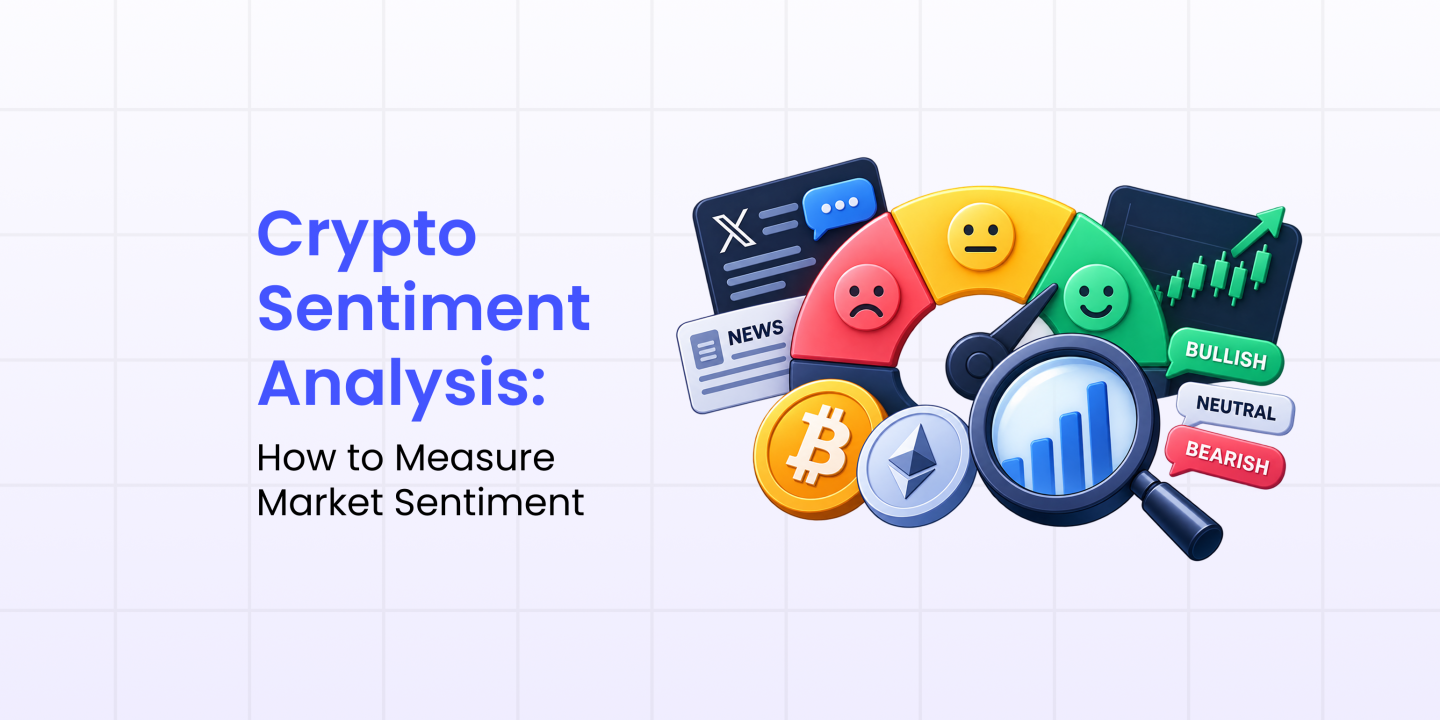
Cryptocurrency sentiment analysis measures the collective emotion of market participants towards an asset, converting social posts, headlines, and positioning data into an actionable signal.
Interpretation is the hard part. Optimism can confirm a young trend or mark the exhaustion of an old one, which is why a working grasp of bull vs bear market crypto cycles matters more than any single reading.
Key Indicators Used in Crypto Sentiment Analysis
No individual metric captures the mood of a market this fragmented. Most traders monitor a small cluster:
- Fear and Greed Index: A composite of volatility, volume, and social data. It earns its keep at the extremes and says little mid-range, as the primer on what is Fear and Greed Index sets out.
- Long-short ratio: This compares open long positions against shorts on futures markets. Retail traders often read a crowded long side as confirmation, when it more often marks fuel for a liquidation cascade. The explainer on what is long short ratio covers the mechanics.
- Funding rates: Persistently positive funding means leveraged buyers are paying to hold positions, and that arrangement rarely lasts.
- Trading volume: Conviction tends to show up in volume before it shows up in price.
How to Perform Sentiment Analysis for Cryptocurrency
Sentiment analysis for cryptocurrency holds up only when it follows a fixed sequence, because the temptation to reinterpret data after a losing trade is strong. The routine below works:
- Collect: Track credible news, social channels, and on-chain activity for the specific asset being traded, not the market as a whole.
- Quantify: Convert observations into numbers, since impressions drift.
- Cross-check: Compare current readings against past instances where similar sentiment preceded a move, and record how often it did not.
- Define risk: Fix entry levels, stop-losses, and position sizes before the signal tempts action.
Best Crypto Sentiment Analysis Tools
Several platforms support the workflow above. The best crypto sentiment analysis stack usually combines social data, derivatives data, and exchange-level metrics.
- Alternative.me publishes the widely referenced Fear and Greed Index.
- LunarCrush and Santiment track social volume and on-chain behaviour.
- Coinglass monitors funding, open interest, and liquidation clusters.
- Pi42, an Indian crypto exchange built around crypto-INR perpetual futures, places live positioning data beside execution, narrowing the gap between reading sentiment and acting on it.
Turning Sentiment into Strategy
Sentiment analysis improves context, not certainty. It works best alongside technical and fundamental research, and disciplined risk management remains essential, particularly when using leverage of up to twenty times. Pi42 supports this approach with INR-denominated perpetual futures, no one percent TDS on trades, and no thirty percent VDA tax, giving Indian traders a clearer framework for acting on market sentiment.
FAQs About Crypto Sentiment Analysis
1) What is crypto sentiment analysis?
Crypto sentiment analysis measures how traders and investors feel about a cryptocurrency by analysing factors such as social activity, news, trading behaviour and market positioning.
2) How does the Fear and Greed Index help crypto traders?
The Fear and Greed Index provides a snapshot of overall market emotion. Extreme fear or greed can help traders identify periods where sentiment may be unusually pessimistic or optimistic.
3) Which indicators are useful for measuring crypto sentiment?
Traders commonly look at the Fear and Greed Index, funding rates, long-short ratios, trading volume, social activity and open interest to build a broader view of market sentiment.
4) Can crypto sentiment predict price movements?
Sentiment can provide useful context, but it cannot reliably predict price direction on its own. Traders should combine sentiment readings with technical analysis and other market data.
5) What are the best tools for crypto sentiment analysis?
Tools such as Alternative.me, LunarCrush, Santiment and Coinglass provide different types of sentiment, social, derivatives and on-chain data that traders can use for analysis.
6) Is crypto sentiment analysis useful for futures trading?
Yes. Sentiment indicators such as funding rates, open interest and long-short ratios can help futures traders understand positioning and identify potentially crowded trades.

Sarvesh Pandey is a growth marketing professional at pi42, where he leads digital acquisition, partnerships, and user growth initiatives in India’s evolving crypto ecosystem. With experience across fintech, EdTech, and consumer internet brands, he shares insights on crypto adoption, trading trends, and performance-led growth strategies.
- Pi42 Head to Trade: Trade & Win the Season’s Biggest Prizes 🎮
 Pi42 Head to Trade is a festive-season trading contest where… Read more: Pi42 Head to Trade: Trade & Win the Season’s Biggest Prizes 🎮
 - Pi42 Snap Fiesta: Refer and Win an Instax Camera This October 📸
 Pi42 Snap Fiesta is an October referral contest that turns… Read more: Pi42 Snap Fiesta: Refer and Win an Instax Camera This October 📸
 - Pi42 BIG TAG: Refer and Win Nothing Buds This September
 Pi42 BIG TAG is a September referral contest that turns… Read more: Pi42 BIG TAG: Refer and Win Nothing Buds This September
 - Leverage in Crypto Trading: Meaning, Benefits & Risks
 Few tools attract as much attention, or cause as much… Read more: Leverage in Crypto Trading: Meaning, Benefits & Risks
 - Big Loot September: Trade & Win a BMW Bike 🏍️
 Big Loot September is Pi42’s biggest reward drop of the… Read more: Big Loot September: Trade & Win a BMW Bike 🏍️