


What is Leverage Trading?
When understanding what is leverage in crypto trading, it’s important to know how leverage can increase both opportunities and risks in the crypto market. Leverage trading enables traders to increase the amount of capital that they can use to trade through the use of borrowed capital.
This technique allows traders to expand their profits while leverage trading crypto, which is good, but since the risks are lifted too, traders face the possibility of losing more as well. In this blog we shall explore the details of leverage trading, making it easy for you to understand what is leverage trading crypto.
How Leverage Trading Works in Crypto Trading?
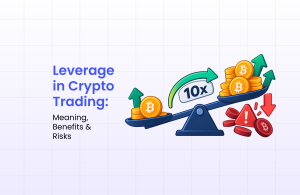
Leverage trading in crypto allows traders to borrow funds from an exchange to open larger positions. By choosing a leverage ratio like 5x or 10x, both potential profits and losses are magnified.
If the market moves in their favor, returns increase, but if it goes against them, losses can quickly lead to liquidation. Proper risk management is crucial when using leverage in crypto trading.
This helps traders better understand what is leverage in crypto trading. Many beginners also search for what is leverage in crypto when learning how borrowed capital works in digital asset markets.
Understanding Leverage Ratios and Margin Requirements
Understanding leverage ratios and margin requirements is crucial for successful trading in this arena of leverage trading crypto. In leverage trading, leverage ratios define the proportion of borrowed capital that can be employed as compared to the trader’s capital.
For instance, a 10:1 leverage means the trader can manage $10 for every $1 of the trader’s money. Further, margin requirements define the amount of money that needs to be kept in the trading account for financing the leveraged positions while conducting crypto leveraging.
For traders wondering what does leverage mean in crypto trading, it refers to increasing market exposure using borrowed funds from an exchange or broker.
Types of Leverage Trading in Crypto
There are several types of leverage trading options available in the crypto market. Here are a few you need to understand to know how to leverage trade crypto:
Margin Trading
It involves using borrowed capital from an exchange or a broker to place a trade of a size that is beyond the trader’s means. Specifically, similar to other margins, trading leveraged with flexible ratios in Pi42 provides an opportunity for traders to seize the opportunities in the market without investing out of their pocket.
This makes it easier for beginners to learn how to trade crypto with leverage.
Expand Your Knowledge: Cross Margin Vs Isolated Margin: Key Differences
Futures Trading
Crypto futures contracts enable users to enter derivative positions that permit one to purchase or sell an underlying asset at a provided rate at a certain time in the future without owning the underlying asset.
Use of leverage in bitcoin futures trading lengthens market risk which has made futures suitable for speculative investment. The futures trading tool that is provided by Pi42 has strong liquidity and also improved types of orders for successful trading.
Such tools also help traders understand how does leverage work in crypto.
Options Trading
Crypto options are contracts giving the buyer the opportunity but not the necessity to buy/sell an asset at a given price to/before a specific date.
Leverage in options trading helps in the maximization of high-profit potential when used, at the same time keeping the risk exposure low. As for options trading in Pi42, it has such fixed characteristics as the strike price and expiration date, but it can be adjusted depending on the chosen trading strategy.
Popular Leverage Trading Strategies with Actionable Examples
Here are some effective strategies, helping traders learn best crypto leverage trading strategies with practical examples:
1. Long Squeeze with Leverage
On the long side global institutions and hedge funds have been caught in Long Squeeze with leverage.
Market makers are able to make a long squeeze where traders who have borrowed stock to invest in an asset that is expected to increase in value are forced to sell in order to cut their losses.
Consequently, by going long with leverage during stable markets and evaluating the pattern of potential squeezes, the trader should be able to reap big during such changes.
2. Short Squeeze with Leverage
A short squeeze is a situation, that occurs if those who borrowed the security to sell it in the future and make a profit given the decline in its price, face losses because of the increase in the security’s price.
Selling can be used by traders at moments when volatility or some kind of insecurity is observed in the market, intending to buy back the same asset at a lower price shortly, thus gaining profits from this operation in the long run.
3. Leveraged Trend Following
In Leveraged Trend Following strategy, a trader takes a leveraged position to follow a trending market’s direction.
Trend following with leverage means that a trader tries to find an opportunity to make a profit by following continuous price trends in the crypto market.
In this way, training can use ‘leverage’ to increase profits several times when trading in the direction of the trend and ‘hedging strategies’ to minimize losses in a reverse market and thus achieve maximum results in the end.
How to Manage Risks in Crypto Leverage Trading
Effective risk management is essential for mitigating potential losses in leverage trading, to accomplish that, one can be mindful of the following:
- Place very aggressive sell-stop loss orders so that no significant amount of capital is at risk.
- The spread is the practice of using as many assets and trading strategies to try and offset the risks of individual assets.
- Further, you should follow all of the events that may influence the market to be aware of market-moving events.
- Utilise all the sophisticated features of Pi42 that will allow you to manage your trading operations, such as margin call notifications and position closeout protection mechanisms.
Traders learning what is crypto leverage trading should always focus on balancing profit opportunities with proper capital protection strategies.
Conclusion
Crypto leverage trading presents a great chance to increase traders’ profit in a high-volatile sphere like crypto. However, it entails an understanding of the use of time-sensitive and established leverage ratios, risks in the market, and their management.
With the help of Pi42, you can understand how to leverage trade crypto and use its sophisticated trading terminal and a wide range of services.
Thereby it becomes possible for you to use it as an opportunity and unlock your true potential. Understanding what does leverage mean in crypto is essential before using higher leverage ratios in live market conditions.
FAQs
1) What is leverage in crypto trading?
Leverage in crypto trading allows traders to borrow funds to open positions larger than their available capital, increasing both profit potential and risk.
2) What is leverage in crypto?
Leverage in crypto refers to using borrowed money from an exchange or broker to gain greater exposure to cryptocurrency price movements.
3) What does leverage mean in crypto trading?
Leverage means amplifying your trading position beyond your actual account balance using margin provided by the exchange.
4) What is crypto leverage trading?
Crypto leverage trading is a trading method where traders use borrowed funds to increase their market position in cryptocurrencies.
5) Is leverage trading crypto risky for beginners?
Yes, leverage trading crypto can be risky for beginners because even small market movements can lead to significant losses or liquidation if risk management is ignored.

Sarvesh Pandey is a growth marketing professional at pi42, where he leads digital acquisition, partnerships, and user growth initiatives in India’s evolving crypto ecosystem. With experience across fintech, EdTech, and consumer internet brands, he shares insights on crypto adoption, trading trends, and performance-led growth strategies.
- Pi42 Snap Fiesta: Refer and Win an Instax Camera This October 📸
 Pi42 Snap Fiesta is an October referral contest that turns… Read more: Pi42 Snap Fiesta: Refer and Win an Instax Camera This October 📸
 - Pi42 BIG TAG: Refer and Win Nothing Buds This September
 Pi42 BIG TAG is a September referral contest that turns… Read more: Pi42 BIG TAG: Refer and Win Nothing Buds This September
 - Leverage in Crypto Trading: Meaning, Benefits & Risks
 Few tools attract as much attention, or cause as much… Read more: Leverage in Crypto Trading: Meaning, Benefits & Risks
 - Big Loot September: Trade & Win a BMW Bike 🏍️
 Big Loot September is Pi42’s biggest reward drop of the… Read more: Big Loot September: Trade & Win a BMW Bike 🏍️
 - Pi42 Week of Wins: Trade & Win a New iPhone This September
 Pi42 Week of Wins is a September contest where every… Read more: Pi42 Week of Wins: Trade & Win a New iPhone This September