
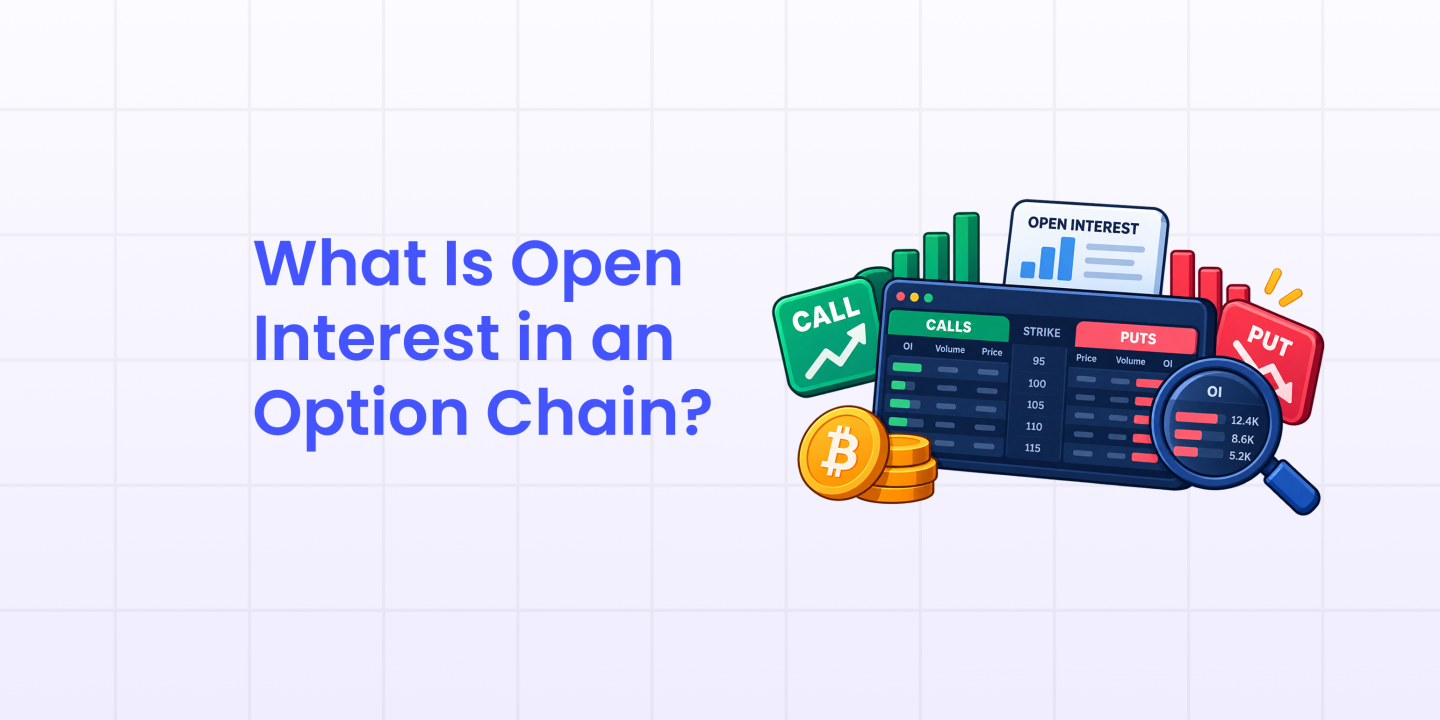
Markets thrive on data. But not all numbers matter equally. So, what is OI in option chain? Think of it as a live headcount of active contracts. While price tells you where an asset is right now, this metric reveals the actual capital holding the line.
If you find yourself asking what is open interest in option chain, you are essentially tracking money that has not yet left the table. It acts as the fuel for future volatility.
How Does Open Interest Work?
Every contract requires two sides. A buyer meets a seller, a trade executes, and the total tally ticks up by one. It really is that simple. The count only drops when participants actually close out their positions.
For traders navigating crypto options trading, this mechanism highlights true liquidity rather than fleeting retail hype. You see exactly how many participants have skin in the game. On platforms like Pi42, understanding this capital flow helps immensely; the platform provides up to 150x leverage on crypto-INR perpetual futures. Higher leverage demands sharper data interpretation.
What is Change in OI in Option Chain?
Order books rarely sit still. Traders constantly monitor what is change in OI in option chain because it functions as a lie detector for price trends. An uptrend backed by rising figures means fresh capital is arriving. The trend has legs. Conversely, if prices spike while the count falls, a sharp reversal might be imminent.
This data proves crucial across diverse market strategies. The core mechanics remain identical whether a trader is dissecting bitcoin options vs. bitcoin spot trading or executing leveraged bitcoin futures trading. Numbers rarely lie. By tracking daily shifts, participants can easily spot institutional footprints before the public catches on.
Open Interest vs Trading Volume
These metrics look similar on a dashboard. They behave entirely differently in practice. Volume counts every single transaction within a specific day, acting much like a turnstile at a busy stadium. However, option chain open interest measures the actual crowd staying in their seats.
Here is how these two concepts separate:
- Lifespan: Volume resets to zero daily. The active contract count carries over indefinitely until settlement.
- Market impact: Huge volume might simply represent day traders swapping the exact same asset back and forth.
- Trend validation: Rising volume paired with a growing contract tally confirms a robust structural market move.
The Data-Driven Advantage
Trading effectively requires looking past the daily noise. Once you understand derivative data, navigating a premier Indian crypto exchange becomes significantly more strategic. Pi42 offers a modern gateway for crypto-INR futures, stripping away traditional friction points that hinder profitability.
Pi42 traders face zero TDS (Tax Deducted at Source). The punishing 30 per cent VDA (Virtual Digital Asset) tax is gone. You can finally set off trading losses. It is an environment built for pure efficiency. Traders get the precise tools to capitalise on market momentum.
FAQs
1. How can open interest help traders identify strong market trends?
A rising open interest alongside increasing prices often suggests that new positions are supporting the trend. Similarly, rising open interest during a downtrend may indicate growing bearish participation. Traders use this information to assess the strength of ongoing market movements.
2. Does high open interest always indicate higher liquidity?
In many cases, yes. Higher open interest generally means more active contracts and better market participation, which can improve liquidity. However, traders should also consider trading volume and bid-ask spreads before entering a position.
3. Can open interest decrease even when prices are rising?
Yes. If traders are closing existing positions instead of opening new ones, open interest can decline despite rising prices. This may indicate that the current trend is losing momentum rather than strengthening.
4. Why do options traders monitor open interest at different strike prices?
Open interest at specific strike prices helps traders identify areas where market participants have concentrated their positions. These levels may act as potential support or resistance during price movements.
5. Is open interest more useful for options or futures trading?
Open interest is valuable for both options and futures markets. It helps traders understand market participation, identify trend strength, and evaluate whether new money is entering or leaving the market.
6. Should open interest be used as a standalone trading indicator?
No. Open interest provides useful insights into market activity but works best when combined with price action, trading volume, technical indicators, and overall market analysis to make informed trading decisions.

Sarvesh Pandey is a growth marketing professional at pi42, where he leads digital acquisition, partnerships, and user growth initiatives in India’s evolving crypto ecosystem. With experience across fintech, EdTech, and consumer internet brands, he shares insights on crypto adoption, trading trends, and performance-led growth strategies.
- Pi42 Head to Trade: Trade & Win the Season’s Biggest Prizes 🎮
 Pi42 Head to Trade is a festive-season trading contest where… Read more: Pi42 Head to Trade: Trade & Win the Season’s Biggest Prizes 🎮
 - Pi42 Snap Fiesta: Refer and Win an Instax Camera This October 📸
 Pi42 Snap Fiesta is an October referral contest that turns… Read more: Pi42 Snap Fiesta: Refer and Win an Instax Camera This October 📸
 - Pi42 BIG TAG: Refer and Win Nothing Buds This September
 Pi42 BIG TAG is a September referral contest that turns… Read more: Pi42 BIG TAG: Refer and Win Nothing Buds This September
 - Leverage in Crypto Trading: Meaning, Benefits & Risks
 Few tools attract as much attention, or cause as much… Read more: Leverage in Crypto Trading: Meaning, Benefits & Risks
 - Big Loot September: Trade & Win a BMW Bike 🏍️
 Big Loot September is Pi42’s biggest reward drop of the… Read more: Big Loot September: Trade & Win a BMW Bike 🏍️