

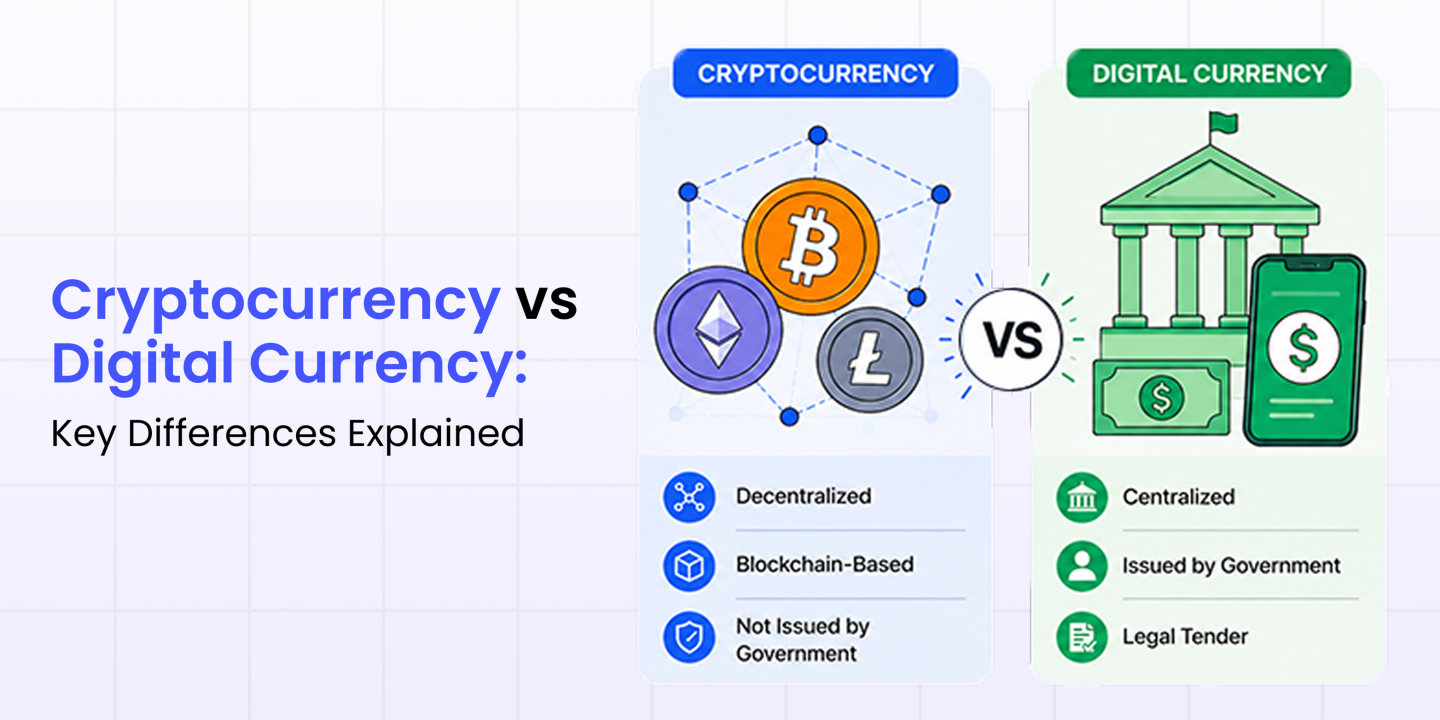
Lately, the migration from physical cash to virtual ledgers has hit hyperdrive, flooding our daily vernacular with new financial jargon. Two of the most dominant concepts are digital currencies and cryptocurrencies.
People use these terms interchangeably. They shouldn’t. Untangling the cryptocurrency vs digital currency debate is no longer optional for modern investors or businesses; it is a foundational necessity. This Pi42 guide strips away the noise to examine these distinct financial assets.
What is Digital Currency?
Think of digital currency as a broad canopy. It is an umbrella term covering everything from the balance rendering in your banking app to government-backed tokens. You cannot hold it in your hand. Instead, it lives entirely on digital computer systems, moving seamlessly across the internet.
Today, Central Bank Digital Currencies (CBDCs) stand as the most credible examples. Issued and strictly monitored by a nation’s central bank, CBDCs act as the digital shadow of a country’s fiat currency (like the digital Rupee, e-CNY, or digital Euro). Because a central authority pulls the strings, their value remains stable and enjoys explicit government backing.
What is Cryptocurrency?
To grasp where these two paths diverge, one must first answer: What is cryptocurrency? Put simply, it is a highly specialised subset of the digital currency world that uses cryptographic principles to lock down transactions. Unlike state-issued virtual money, cryptocurrencies reject the concept of a central authority.
They run on blockchain technology, operating as a decentralised, distributed public ledger. A vast network of independent participants (nodes) verifies transactions rather than a single bank. Think Bitcoin, Ethereum, or stablecoins. They champion borderless transfers, open access, and ultimate individual custody.
Digital Currency vs Cryptocurrency: Key Differences
When sizing up digital currency vs cryptocurrency, they mimic each other on the surface since both exist purely as data. However, their architectural DNA could not be more opposed. Let’s break down where the fault lines lie.
Centralization vs Decentralization
Control is the ultimate difference between crypto and digital currency. Digital currencies (like CBDCs) are fiercely centralised. A governing body dictates the supply, watches every transfer, and holds the power to freeze assets outright. Cryptocurrencies flip this model. They are natively decentralised. No single entity manages a public blockchain; instead, the ecosystem survives on hard-coded protocols and community consensus.
Transparency and Security
Cryptocurrencies lean heavily into public transparency. The blockchain records every single movement, visible to anyone with an internet connection, though the actual humans behind the transactions remain pseudo-anonymous behind alphanumeric wallet addresses. Traditional digital currencies take a walled-garden approach. Private ledgers handle the data. The central issuing authority demands absolute visibility into your spending habits, while the general public gets zero access to that ledger.
Regulation and Legal Status
Because CBDCs carry the state’s blessing, they function as legal tender. They slide flawlessly into existing regulatory frameworks. Cryptocurrencies, however, navigate a notoriously fractured legal landscape. Some nations welcome them with open arms. Others draft aggressive restrictions or outright bans, wary of the lack of centralised oversight.
Technology and Infrastructure
Crypto relies on public, open-source blockchains locked down by Proof of Work (PoW) or Proof of Stake (PoS) consensus mechanisms. Conversely, government-backed digital currencies lean on permissioned, closed-loop databases. You need strict approval to play in a CBDC network, typically reserved for heavy-hitting financial institutions.
How Digital Currency and Cryptocurrency Work
The mechanical difference between crypto currency and digital currency is found in the validation process. Send a CBDC to a vendor, and a central bank’s private server verifies your identity, checks your balance, and signs off.
Send Bitcoin, and you broadcast that intent to a sprawling, global network of independent miners or validators. They deploy heavy cryptographic lifting to bundle your transfer into a “block” and stamp it onto the blockchain.
Use Cases of Digital Currency vs Cryptocurrency
When viewing digital money vs cryptocurrency through the harsh lens of market application, their distinct specialities become obvious.
- Digital Currency (CBDCs): Built for frictionless domestic payments, deploying government aid with pinpoint accuracy, and meshing with legacy banking without the headache of price swings.
- Cryptocurrency: Dominates the realm of rapid, low-cost cross-border payments and decentralised finance (DeFi). It offers a lifeline to unbanked populations. Stablecoins, specifically, give businesses global reach without the chaotic volatility of unpegged assets.
Furthermore, the rise of tokenisation enables fractional ownership of “real-world assets” (RWAs) such as property or fine art.
Advantages and Limitations of Both
Neither asset class is flawless. Let’s look at the trade-offs.
- Advantages of Digital Currencies: They deliver ironclad price stability and legal safety. Businesses love the straightforward integration.
- Limitations of Digital Currencies: They suffer from deep privacy concerns and remain boxed in by geopolitical borders.
- Advantages of Cryptocurrencies: They offer unprecedented financial sovereignty and global reach. Nobody can manipulate the central supply.
- Limitations of Cryptocurrencies: Regulatory turbulence and wild price swings are serious liabilities. In fact, risk managers often weigh the Stock Market vs Cryptocurrency to figure out which volatile asset class aligns with their specific tolerance.
Which is Better: Digital Currency or Cryptocurrency?
Asking which is “better” misses the mark entirely. In the broader crypto vs digital currency ecosystem, context dictates value. If you demand rigid stability, legal cover, and localised spending power, centralised options win. If your strategy requires privacy, borderless interoperability, and independence from legacy banks, crypto takes the crown.
Industry veterans at platforms like Pi42 largely agree that it isn’t a zero-sum game. The financial future points toward a hybrid model. Both systems continue evolving as technology and regulations shape the future of finance. We will likely see CBDCs and decentralised stablecoins running parallel across the global economy.
A Much-Needed Discussion
The ongoing crypto currency vs digital currency conversation exposes exactly how fast global finance is rewiring itself. Yes, all cryptocurrencies fall under the digital currency umbrella, but very few digital currencies carry the cryptographic freedom of true crypto. Master these distinct lines across centralization, public transparency, and infrastructure. Once you do, navigating the new digital economy becomes a matter of strategy rather than guesswork.
FAQ’s – Digital Currency vs Cryptocurrency
1) What is the difference between cryptocurrency and digital currency?
Digital currency is centrally controlled by governments or banks, while cryptocurrency operates on decentralised blockchain networks without a central authority.
2) Is Bitcoin a digital currency?
Yes, Bitcoin is a type of digital currency, but unlike CBDCs or bank-issued digital money, it is decentralised and runs on blockchain technology.
3) Are cryptocurrencies legal in India?
Cryptocurrencies are not legal tender in India, but buying, selling, and holding them is allowed under the current tax and compliance framework.
4) Which is safer: cryptocurrency or digital currency?
Digital currencies backed by governments are generally more stable, while cryptocurrencies offer decentralisation but come with higher volatility and regulatory risks.
5) What are the advantages of cryptocurrency over digital currency?
Cryptocurrencies offer borderless transactions, decentralisation, transparency, and greater user control compared to centrally managed digital currencies.
6) Can digital currencies replace cryptocurrencies?
Digital currencies and cryptocurrencies are likely to coexist, as both serve different purposes in the evolving financial ecosystem.

Sarvesh Pandey is a growth marketing professional at pi42, where he leads digital acquisition, partnerships, and user growth initiatives in India’s evolving crypto ecosystem. With experience across fintech, EdTech, and consumer internet brands, he shares insights on crypto adoption, trading trends, and performance-led growth strategies.
- Pi42 Snap Fiesta: Refer and Win an Instax Camera This October 📸
 Pi42 Snap Fiesta is an October referral contest that turns… Read more: Pi42 Snap Fiesta: Refer and Win an Instax Camera This October 📸
 - Pi42 BIG TAG: Refer and Win Nothing Buds This September
 Pi42 BIG TAG is a September referral contest that turns… Read more: Pi42 BIG TAG: Refer and Win Nothing Buds This September
 - Leverage in Crypto Trading: Meaning, Benefits & Risks
 Few tools attract as much attention, or cause as much… Read more: Leverage in Crypto Trading: Meaning, Benefits & Risks
 - Big Loot September: Trade & Win a BMW Bike 🏍️
 Big Loot September is Pi42’s biggest reward drop of the… Read more: Big Loot September: Trade & Win a BMW Bike 🏍️
 - Pi42 Week of Wins: Trade & Win a New iPhone This September
 Pi42 Week of Wins is a September contest where every… Read more: Pi42 Week of Wins: Trade & Win a New iPhone This September