
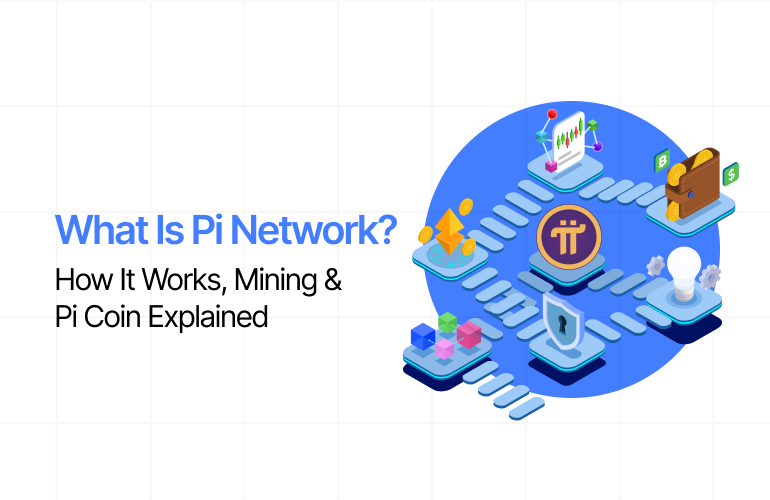
Pi Network is a Layer-1 blockchain project founded on March 14, 2019 — Pi Day — by Stanford PhDs Dr. Nicolas Kokkalis and Dr. Chengdiao Fan. Built as a mobile-first crypto ecosystem, it broadens participation through social trust and identity verification rather than energy-intensive computation.
What Is Pi Network And How Does It Work?
Pi Network runs on the Stellar Consensus Protocol (SCP), a Federated Byzantine Agreement (FBA) model — a form of blockchain technology through which nodes reach agreement via overlapping groups of trusted participants called quorum slices. No cryptographic puzzle-solving, no energy-heavy competition that defines Bitcoin’s Proof-of-Work.
“Mining” here carries a different meaning than it does in Bitcoin. For most app users, it describes a participation-based reward system tied to engagement, social trust, and network growth. Transaction validation is handled separately, through Pi’s node-based consensus design.
How Does Pi Network Mining Work?
The mechanics of how does Pi Network mining work are straightforward: no cryptographic puzzles, no competing to add blocks from a smartphone. Pi rewards participation — user activity, trust relationships, and network contribution — while transaction validation runs through the node and consensus design.
Mobile Mining Process
Users activate mining by opening the app once every 24 hours.
Key factors influencing rewards include:
- Base rate: A standard earning rate that has declined over time as the network has matured
- Referral bonus: Additional rewards tied to invited users who actively participate
- Security circle contribution: Potential reward benefits linked to trusted connections
- Node participation: Running a node may support the network and can play a role in the broader ecosystem
Role Of Security Circles
Security circles are central to how Pi Network establishes trust. Each user selects a group of trusted individuals, and those relationships feed into a broader trust graph across the network. They don’t manually approve transactions — they shape the trust structure that informs consensus across nodes, filtering out fake or low-trust participation in the process.
What Is Pi Network Mining Model?
The mining model combines social verification, recurring user participation, and ecosystem growth incentives to distribute rewards. Accessibility and community contribution drive the design, not raw computing power, with reward rates declining steadily as the network matures.
What Is a Pi Coin?
What is Pi coin? It is Pi Network’s native digital asset — the currency through which its peer-to-peer transfers, applications, and ecosystem services are meant to operate. Pi has published a maximum supply framework of 100 billion Pi, though actual usable balances hinge on migration, lockups, and network participation rules.
Potential use cases associated with Pi include:
- Peer-to-peer transfers within the network
- Transactions within Pi-based applications
- Merchant payments where accepted
- Ecosystem participation as Pi network mainnet utility develops
Utility and liquidity remain in development. Early ecosystem growth is not a reliable indicator of long-term value.
Pi Network Mainnet And Current Status
The Pi Network mainnet evolved through multiple stages before reaching its Open Network phase.
The development timeline includes:
- Bootstrap Phase (March 14, 2019 to March 14, 2020): Initial launch and community growth
- Testnet Phase (March 14, 2020 to December 28, 2021): Network testing and node development
- Enclosed Mainnet (from December 28, 2021): Mainnet blockchain launch with external connectivity initially restricted
- Open Network (from February 20, 2025 at 8:00 AM UTC): External connectivity enabled for the broader ecosystem
The Mainnet launched in late 2021, but between then and February 20, 2025, Pi ran in an enclosed environment. KYC, migration, app development, and ecosystem preparation all continued in that window. KYC-verified users could migrate balances and use Pi within the enclosed ecosystem as rollout progressed.
Open Network enabled broader external connectivity. Access to deposits, withdrawals, and trading still varies by platform and region.
How To Start Using Pi Network?
Creating An Account
To begin using Pi Network:
- Download the official app from a trusted source
- Register using a supported method such as a phone number or social account
- Enter a valid invitation code if required by the signup flow
- Begin participating through the app
- Complete KYC verification and the Mainnet Checklist later if you want Mainnet migration and fuller ecosystem access
Earning And Using Pi
Users can activate daily mining sessions through the app after registration.
To optimise participation:
- Maintain consistent daily activity
- Build a reliable security circle
- Invite users responsibly
- Complete KYC and Mainnet migration when eligible
After migration, Pi may be used within supported applications and peer-to-peer activity where enabled. External transfer or trading availability depends on platform policies and applicable compliance requirements.
Benefits And Limitations Of Pi Network
Benefits:
- No hardware-intensive mobile mining process
- More energy-efficient design than Proof-of-Work systems
- Simple onboarding through a smartphone app
- A growing ecosystem vision centred on broader participation
Limitations:
- Declining mining rewards over time
- Utility still developing relative to more mature crypto networks
- Ongoing questions from critics about decentralisation and execution
- A token model whose long-term value depends on real adoption, not just user count
Risks And Concerns Around Pi Network
Key concerns include:
- Delayed utility: There was a long gap between initial launch and Open Network
- Centralisation concerns: Critics have questioned how decentralised the network is in practice during its staged rollout
- Scam exposure: Fraudulent apps, fake listings, and phishing attempts can target users
- Price uncertainty: Any market discovery remains highly volatile and venue-dependent
- No guaranteed returns: Value depends on adoption, utility, liquidity, and execution
So, What Is Pi Network In Crypto?
Pi Network lowers the barrier to crypto participation through smartphones and social trust rather than hardware or technical know-how. How Pi Network works — rewarding engagement over computation — is what sets it apart from most blockchain projects. Open Network is live, but long-term utility and ecosystem adoption are still finding their footing. Indian readers should factor in local tax and compliance realities before buying, selling, or transferring any digital assets through a crypto trading platform in India.
Pi42 also offers INR-margined crypto derivatives — futures and options — built around an India-first, compliance-focused experience. As a crypto trading platform in India, Pi42 provides a derivatives-first model designed for traders seeking a regulated and INR-settled crypto trading experience.
FAQ’s – Pi Network
1) What is Pi Network?
Pi Network is a mobile-first Layer-1 blockchain project that allows users to participate in crypto through smartphones, using social trust and identity verification instead of energy-intensive mining.
2) How does Pi Network work?
Pi Network operates on the Stellar Consensus Protocol, where transactions are validated through a trust-based system of nodes rather than competitive mining like traditional cryptocurrencies.
3) How does Pi Network mining work?
Pi mining is based on user participation, such as daily app activity, referrals, and security circles, rather than solving complex cryptographic problems.
4) What is a Pi coin?
Pi coin is the native digital asset of the Pi Network, designed for peer-to-peer transactions, app usage, and ecosystem participation within the network.
5) Is Pi Network real or legit?
Pi Network is a real project with an active user base and mainnet, but its long-term value depends on adoption, utility, and ecosystem development, which are still evolving.
6) Can Pi coin be traded or withdrawn?
Trading and withdrawals depend on platform availability and regional regulations, as access expanded after the Open Network phase but is still limited in some areas.
7) What are the risks of using Pi Network?
Risks include limited current utility, price uncertainty, centralisation concerns, and exposure to scams or fake apps targeting users.

Sarvesh Pandey is a growth marketing professional at pi42, where he leads digital acquisition, partnerships, and user growth initiatives in India’s evolving crypto ecosystem. With experience across fintech, EdTech, and consumer internet brands, he shares insights on crypto adoption, trading trends, and performance-led growth strategies.
- Pi42 Tick Together: Refer and Win an Armani Watch ⌚
 Pi42 Tick Together is a festive-season referral contest where your… Read more: Pi42 Tick Together: Refer and Win an Armani Watch ⌚
 - Pi42 Delisting: 74 USDT Futures Contracts on 29 October 2026
 As part of our periodic Market Quality Review, Pi42 is… Read more: Pi42 Delisting: 74 USDT Futures Contracts on 29 October 2026
 - Pi42 Head to Trade: Trade & Win the Season’s Biggest Prizes 🎮
 Pi42 Head to Trade is a festive-season trading contest where… Read more: Pi42 Head to Trade: Trade & Win the Season’s Biggest Prizes 🎮
 - Pi42 Snap Fiesta: Refer and Win an Instax Camera This October 📸
 Pi42 Snap Fiesta is an October referral contest that turns… Read more: Pi42 Snap Fiesta: Refer and Win an Instax Camera This October 📸
 - Pi42 BIG TAG: Refer and Win Nothing Buds This September
 Pi42 BIG TAG is a September referral contest that turns… Read more: Pi42 BIG TAG: Refer and Win Nothing Buds This September