
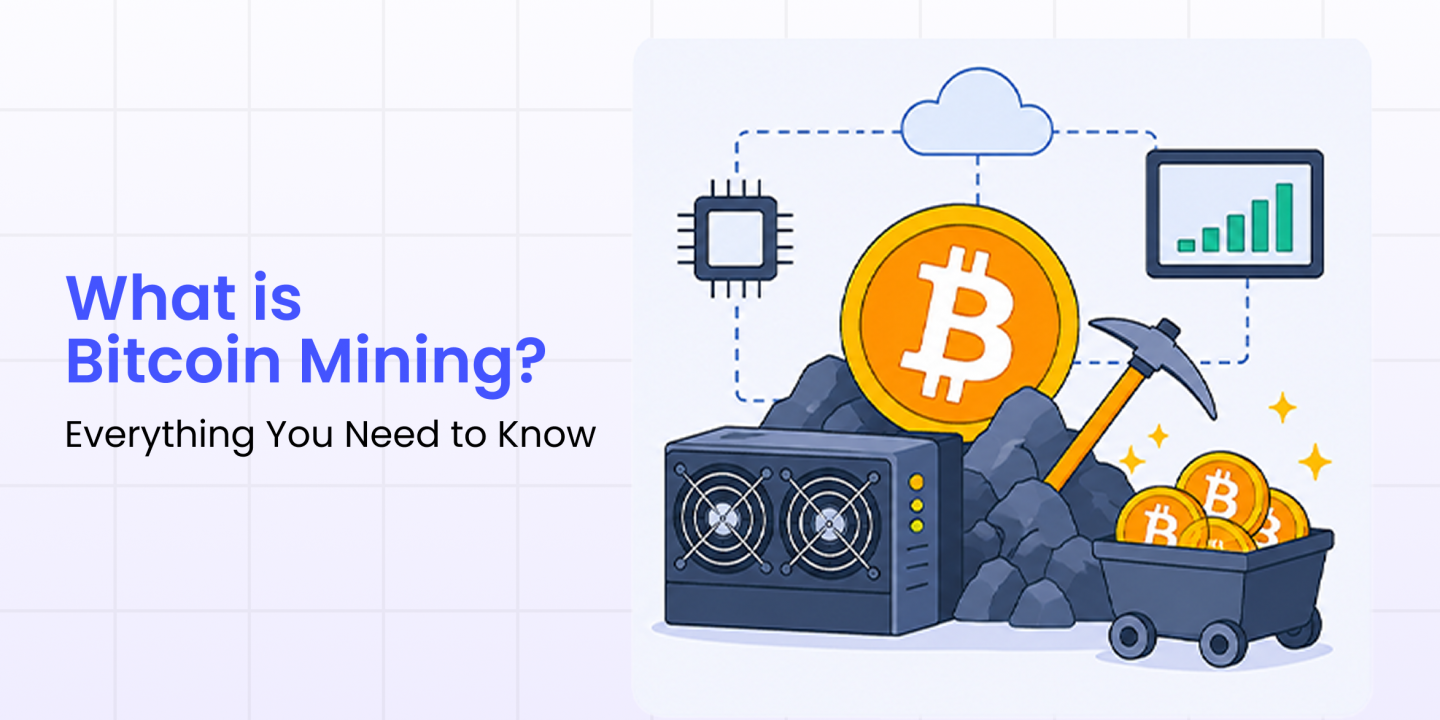
Bitcoin does not depend on a bank or payment company to approve transactions. It runs on a decentralised network.
When people ask what is bitcoin mining, they are usually trying to understand how Bitcoin transactions are verified. How does new Bitcoin enter circulation?
Bitcoin Mining Meaning and Overview
The bitcoin mining meaning is the process of validating Bitcoin transactions through specialised computing hardware.
Every verified transaction becomes part of Bitcoin’s public ledger. This ledger is maintained using blockchain technology.
Bitcoin has a fixed maximum supply of 21 million coins. New coins are released through mining rewards, not through a central bank. This is why mining is closely connected to Bitcoin’s scarcity model.
Some beginners search what are bitcoins mining because the phrase can sound like coins are being dug out of the internet.
That is not quite right. Bitcoin miners are not finding hidden coins. They are competing to secure the network and earn rewards for valid work.
Today, Bitcoin mining is no longer practical on ordinary laptops or phones. The network is dominated by ASIC machines. These are built specifically for mining.
How Does Bitcoin Mining Work?
To understand how does bitcoin mining work, picture thousands of machines in a race to update the same public record.
Miners collect pending transactions, verify them, and attempt to add a new block to the blockchain. The winning miner earns the reward. But the rest of the network still checks whether the block is valid.
Transaction Verification
Each Bitcoin transaction includes a sender, a receiver, an amount, and a digital signature. Miners verify that the sender has enough Bitcoin and that the transaction follows network rules.
They also help prevent double-spending. This means the same Bitcoin cannot be used twice.
In traditional finance, a bank handles this job. In Bitcoin, the network does it collectively.
Proof of Work Mechanism
Bitcoin uses Proof of Work. This means miners must spend real computing effort before they can add a block.
The machines repeatedly generate hashes until one meets Bitcoin’s difficulty target. A hash is a digital fingerprint of block data.
This process consumes electricity. But it also makes Bitcoin difficult to attack. Rewriting transaction history would require huge computing power.
Block Creation Process
Once a miner finds a valid hash, the new block is broadcast to the network. Other participants verify it.
If the block is accepted, it is added to the chain. The miner receives the block reward and transaction fees.
Bitcoin adjusts mining difficulty roughly every 2,016 blocks. This helps keep block creation close to a 10-minute rhythm.
What is the Purpose of Bitcoin Mining?
Many users ask what is the use of bitcoin mining because they see it only as a reward system.
Its real purpose is trust. Mining allows people who do not know each other to agree on one shared transaction history.
For traders, mining data can also be useful. Halving cycles, miner selling, transaction fees, and rising difficulty can influence Bitcoin’s price behaviour.
Bitcoin Options vs. Bitcoin Spot Trading becomes easier to evaluate when users understand what affects Bitcoin supply.
Bitcoin Futures Trading can also be viewed more clearly when traders know how mining events may affect volatility.
Types of Bitcoin Mining Methods
Bitcoin mining can be done in different ways.
Solo Mining
The miner owns the hardware, pays for electricity, manages cooling, and keeps the full reward if a block is mined.
The challenge is probability. Without massive computing power, the chance of mining a block alone is extremely low.
For most Indian retail users, solo mining is not realistic. Equipment and electricity costs are high enough to eat into their margins.
Pool Mining
Pool mining allows miners to combine computing power.
When the pool mines a block, the reward is shared among participants based on their contributions. This gives smaller miners more regular payouts.
Before joining a pool, users should check fees, payout rules, withdrawal terms, and reputation.
Cloud Mining
Cloud mining lets users rent mining power from a company.
The company claims to handle machines, electricity, cooling, and maintenance. This sounds convenient, but it carries a serious risk.
Many fake platforms use mining language to sell unrealistic income plans. Any service promising fixed daily profits should be treated with caution.
Costs and Profitability of Bitcoin Mining
The major costs include ASIC machines, power consumption, cooling, repairs, internet, pool fees, and setup expenses.
In India, electricity prices vary by state and usage category. That difference can decide whether mining is profitable or loss-making.
A miner may earn Bitcoin and still lose money if operating costs are too high. Older machines can also become unprofitable when network difficulty rises.
Risks and Challenges in Bitcoin Mining
Bitcoin mining has several practical risks.
Hardware can become outdated. Machines can overheat. Electricity bills can rise. Bitcoin prices can fall quickly.
Scams are another major concern. Fake cloud mining websites, wallet traps, and guaranteed-return offers often target beginners.
There is also a cybersecurity risk called cryptojacking. In this attack, malware secretly uses someone’s device to mine crypto.
Is Bitcoin Mining Safe and Legal?
Mining itself is a technical process. Hence, it is not automatically unsafe.
It becomes risky when users rely on fake platforms, weak wallet security, or poor hardware management.
In India, crypto assets are covered under the Virtual Digital Asset tax framework. Crypto income and transactions may attract tax and TDS obligations.
Bitcoin is not legal tender in India. Anyone planning large-scale mining should review tax rules, electricity usage, hardware imports, and business compliance.
Final Thoughts on Bitcoin Mining
For anyone still wondering what exactly is bitcoin mining, the simplest answer is that it is Bitcoin’s security and transaction-confirmation system.
For Indian users, mining is worth understanding. But it is not always practical to pursue. High electricity costs, specialised hardware, taxation, and scams make it a serious decision.
Even if you never mine Bitcoin, understanding how mining works can help you better interpret Bitcoin’s supply, security, and market behaviour. If you’re looking for a trusted Indian crypto exchange to participate in the crypto ecosystem without the complexities of mining, Pi42 offers a seamless trading experience.
FAQ’s – Bitcoin Mining
1) What is Bitcoin mining in simple words?
Bitcoin mining is the process of verifying Bitcoin transactions and adding them to the blockchain using powerful computers.
2) How do Bitcoin miners earn money?
Bitcoin miners earn rewards in the form of newly created Bitcoins and transaction fees for successfully validating blocks.
3) Can you mine Bitcoin on a mobile phone or laptop?
No, Bitcoin mining today mainly requires specialised ASIC hardware, making ordinary phones and laptops impractical for profitable mining.
4) Is Bitcoin mining profitable in India?
Profitability depends on electricity costs, mining hardware efficiency, Bitcoin prices, and mining difficulty, which can make mining challenging in India.
5) What are the different types of Bitcoin mining?
The main types are solo mining, pool mining, and cloud mining, each with different costs, risks, and reward structures.
6) Is Bitcoin mining legal in India?
Bitcoin mining is not banned in India, but miners must comply with tax, electricity, and regulatory requirements.

Sarvesh Pandey is a growth marketing professional at pi42, where he leads digital acquisition, partnerships, and user growth initiatives in India’s evolving crypto ecosystem. With experience across fintech, EdTech, and consumer internet brands, he shares insights on crypto adoption, trading trends, and performance-led growth strategies.
- Pi42 Snap Fiesta: Refer and Win an Instax Camera This October 📸
 Pi42 Snap Fiesta is an October referral contest that turns… Read more: Pi42 Snap Fiesta: Refer and Win an Instax Camera This October 📸
 - Pi42 BIG TAG: Refer and Win Nothing Buds This September
 Pi42 BIG TAG is a September referral contest that turns… Read more: Pi42 BIG TAG: Refer and Win Nothing Buds This September
 - Leverage in Crypto Trading: Meaning, Benefits & Risks
 Few tools attract as much attention, or cause as much… Read more: Leverage in Crypto Trading: Meaning, Benefits & Risks
 - Big Loot September: Trade & Win a BMW Bike 🏍️
 Big Loot September is Pi42’s biggest reward drop of the… Read more: Big Loot September: Trade & Win a BMW Bike 🏍️
 - Pi42 Week of Wins: Trade & Win a New iPhone This September
 Pi42 Week of Wins is a September contest where every… Read more: Pi42 Week of Wins: Trade & Win a New iPhone This September