
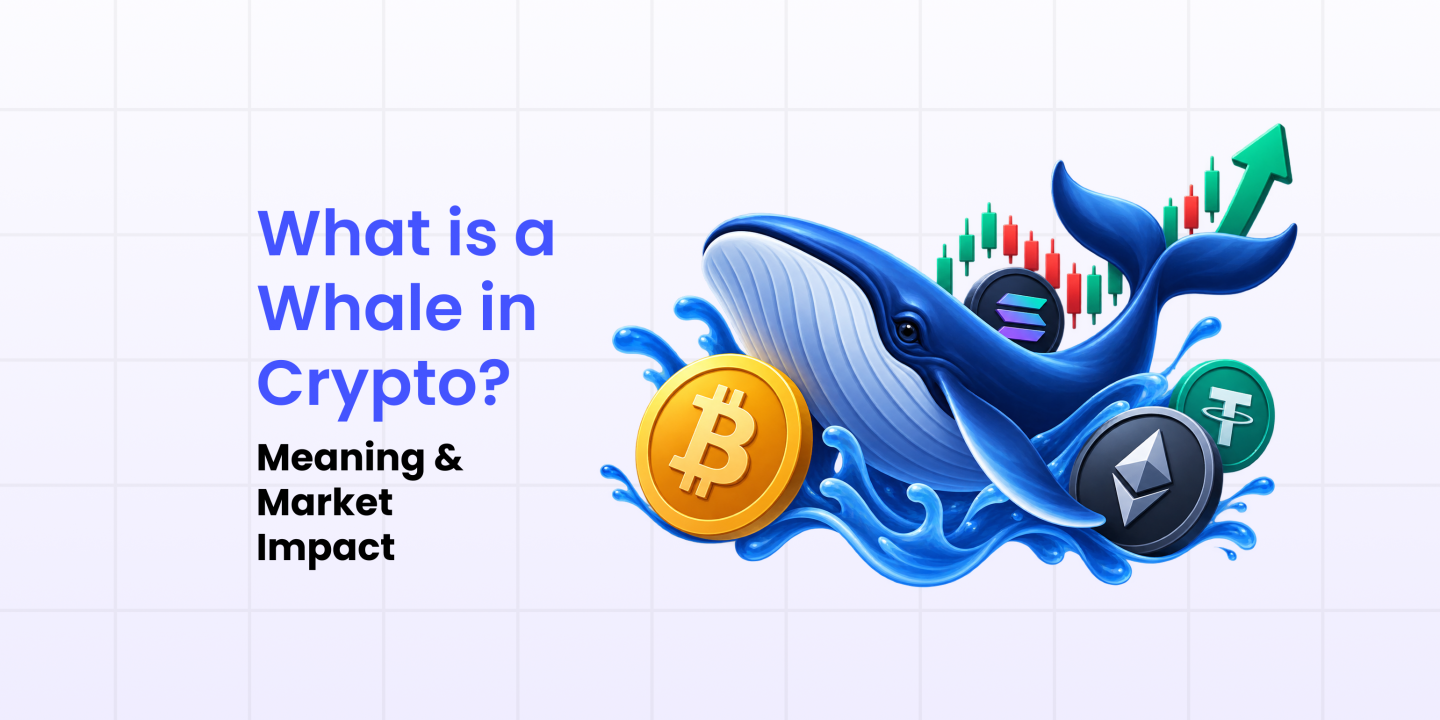
A single wallet moving thousands of Bitcoin can shift market sentiment within minutes. Indian traders watch these transfers closely, which raises a practical question: what is whale in crypto terms, and why does one holder carry so much weight?
What Does Whale Mean in Crypto?
A crypto whale is an individual or entity holding enough of a cryptocurrency to influence its price through a single transaction. No official threshold exists. However, ownership of 1,000 BTC or more is widely treated as the benchmark for Bitcoin. Comparable thresholds apply elsewhere. These vary as per each token’s supply.
Traders asking what are crypto whales generally encounter four groups:
- Early adopters: Holders who accumulated assets cheaply and stayed through multiple cycles
- Protocol founders: Creators who retain a large share of their network’s native tokens
- Institutional investors: Hedge funds, venture firms and corporate treasuries with dedicated allocations
- Exchanges: Platforms holding sizeable reserves to support liquidity (the ease of buying or selling without moving the price)
How Do Crypto Whales Influence the Market?
Whale activity reaches the market through several distinct channels:
- Price volatility: Large orders absorb available depth in the order book, producing sharp moves in either direction
- Liquidity conditions: Dormant holdings reduce tradable supply and widen slippage (the gap between expected and executed price)
- Sentiment: Withdrawals often read as accumulation, while deposits suggest selling pressure. Traders gauging this frequently ask what is Fear and Greed Index, a single-score measure of market mood
- Manipulation: Tactics such as spoofing (placing and cancelling large orders) can resemble pump and dump crypto patterns
- Governance: In proof-of-stake networks, voting power scales with holdings. This concentrates decision-making.
Why Do Traders Monitor Crypto Whale Activity?
Anyone researching what are whales in cryptocurrency quickly discovers that blockchains are public, so large transfers are visible in real time. On-chain analytics platforms flag these movements, and traders use them as one input among many when assessing a bull vs bear market crypto environment.
A transfer between two wallets owned by the same custodian looks identical to a genuine sale, so signals require verification before any position is sized around them.
Risks and Opportunities of Following Crypto Whales
Traders should weigh these aspects carefully:
- Whales operate on longer time horizons and far larger balance sheets than retail participants
- On-chain data appears after execution, meaning the price impact may already have occurred
- Leverage amplifies losses when a whale-driven move reverses quickly
For Indian traders, execution venue matters as much as the signal itself. Pi42 offers crypto-INR perpetual futures with zero TDS, settlement in rupees and the ability to set off losses, features worth comparing when evaluating the best Indian cryptocurrency exchange for derivatives.
The Bigger Picture
Whales are a structural feature of concentrated markets, not an anomaly. Those still wondering what does whale mean in crypto can treat it simply: a holder large enough to move prices. Tracking their behaviour sharpens market awareness, though disciplined risk management remains the deciding factor in long-term trading outcomes.
FAQs About Crypto Whales
1) How much crypto does it take to be considered a whale?
There is no fixed amount that officially defines a whale. For Bitcoin, holding around 1,000 BTC or more is commonly used as a general benchmark, while the threshold varies for other cryptocurrencies.
2) Who can be a crypto whale?
Crypto whales can include early investors, project founders, institutional investors, and even cryptocurrency exchanges that hold large amounts of digital assets.
3) Can crypto whales control the price?
Large trades can significantly affect price, especially when market liquidity is low. However, whale activity alone does not guarantee that the price will move in a particular direction.
4) How can traders track whale activity?
Traders can monitor large blockchain transactions and wallet movements using on-chain analytics platforms and blockchain explorers such as Etherscan.
5) Does a large whale transfer mean the crypto will be sold?
Not necessarily. A transfer could be between wallets belonging to the same owner or an exchange. Traders should verify the context before treating it as a selling signal.
6) Should traders follow crypto whale movements?
Whale activity can provide useful market information, but it should not be the only factor behind a trading decision. Price action, liquidity, market sentiment and risk management also matter.

Sarvesh Pandey is a growth marketing professional at pi42, where he leads digital acquisition, partnerships, and user growth initiatives in India’s evolving crypto ecosystem. With experience across fintech, EdTech, and consumer internet brands, he shares insights on crypto adoption, trading trends, and performance-led growth strategies.
- Big Loot September: Trade & Win a BMW Bike 🏍️
 Big Loot September is Pi42’s biggest reward drop of the… Read more: Big Loot September: Trade & Win a BMW Bike 🏍️
 - Pi42 Week of Wins: Trade & Win a New iPhone This September
 Pi42 Week of Wins is a September contest where every… Read more: Pi42 Week of Wins: Trade & Win a New iPhone This September
 - Chandi Utsav: Refer and Win Silver Coin
 This September, turn your referrals into something worth its weight!… Read more: Chandi Utsav: Refer and Win Silver Coin
 - Booked by Pi42: Amsterdam Awaits — Trade More, Travel More ✈️
 Booked by Pi42 is a trading contest that could send… Read more: Booked by Pi42: Amsterdam Awaits — Trade More, Travel More ✈️
 - Pi42 Bandhan Bonus: Win Amazon Gift Vouchers This Rakhi
 Pi42 Bandhan Bonus is a Rakhi referral contest where you… Read more: Pi42 Bandhan Bonus: Win Amazon Gift Vouchers This Rakhi