
With Iran’s repeated closures and reopenings of the Strait of Hormuz sending shockwaves through global oil markets—and crypto prices swinging sharply on every headline—the link between geopolitics and Bitcoin price has never been more visible. Reports have even emerged of Bitcoin and stablecoins being used as settlement instruments for Strait of Hormuz passage tolls, a development that would have seemed unthinkable just a few years ago.
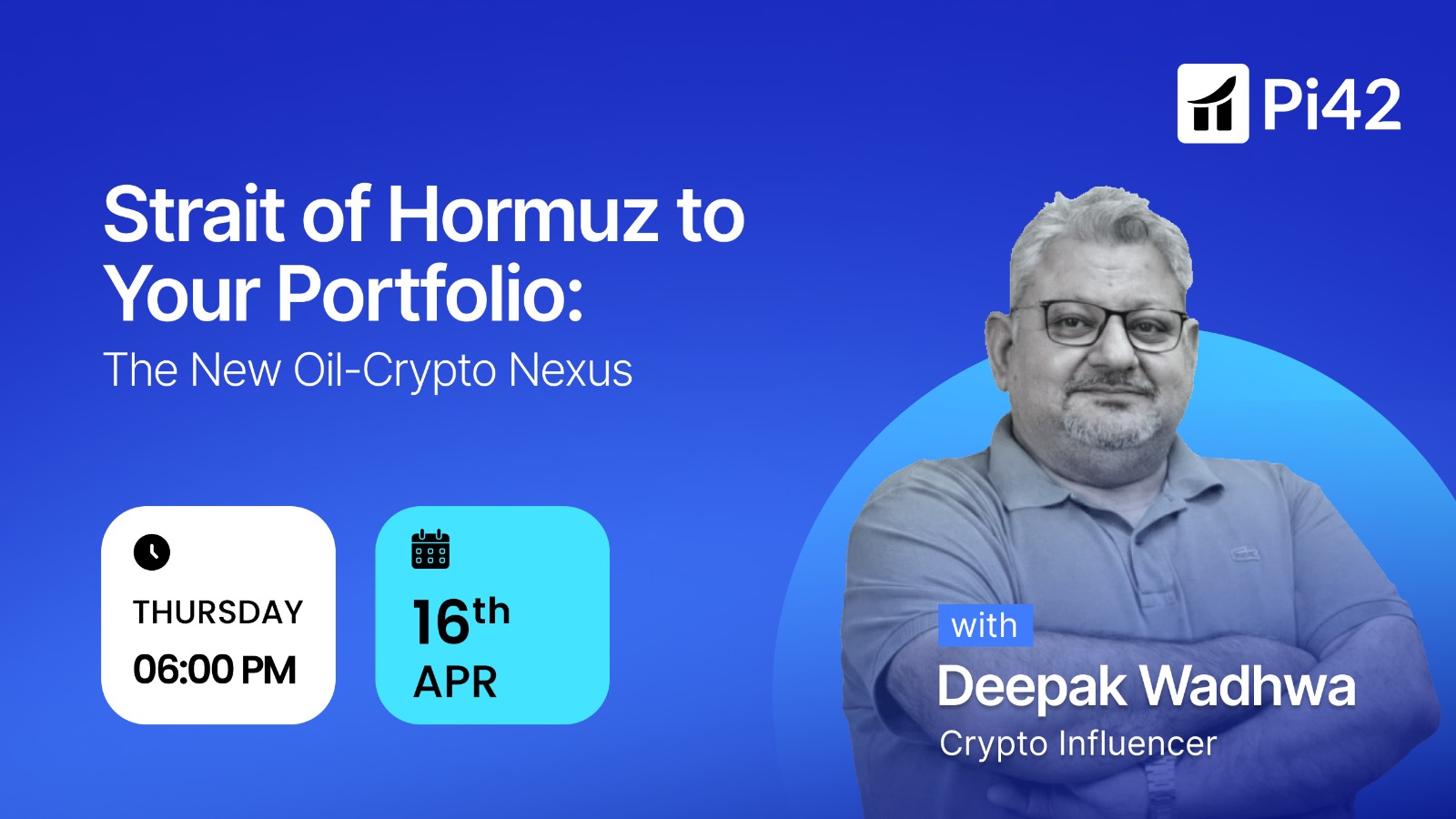
In a recent Pi42 AMA with Deepak Wadhwa (@bwithdeepak), the conversation mapped the invisible wiring connecting oil, currencies, geopolitics, and digital assets. The takeaway wasn’t a price prediction. It was something more valuable: a macro framework for crypto traders to think clearly when the world feels noisy.
If you’re trading crypto in India or anywhere else without understanding this layer, you’re trading with half the picture.
Crypto is no longer a closed loop: the macro-crypto nexus
It’s tempting to treat crypto as its own universe—a self-contained cycle of halvings, ETF flows, and on-chain metrics. That view is outdated.
Global markets today are deeply interconnected. Crypto liquidity is driven by macro conditions—energy supply chains, trade routes, currency systems, and central bank policy all shape capital flows across every asset class, crypto included. When the dollar strengthens globally, risk assets feel it. When oil spikes, inflation expectations shift, central banks react, and the cost of capital changes for everyone—from a hedge fund in New York to a retail trader running leverage on Pi42.
Understanding how geopolitics affects Bitcoin price doesn’t mean becoming an economist. It means recognizing that the context around a trade is often more important than the trade itself.
Why oil prices and Bitcoin are more connected than you think
Oil remains one of the most consequential macro variables on the planet. It feeds into transportation, food supply chains, manufacturing costs, and inflation expectations. When oil moves sharply, financial markets react—sometimes quietly, sometimes violently.
The Bitcoin oil price correlation works through a transmission chain most retail traders overlook:
- Oil spikes → inflation expectations rise
- Central banks tighten or delay cuts → dollar strengthens
- Global liquidity contracts → risk assets sell off
- Bitcoin, as a high-beta risk asset, feels the pressure first
This is where geography enters the conversation.
The Strait of Hormuz: the chokepoint reshaping crypto markets in 2026
The Strait of Hormuz is a narrow waterway between Iran and Oman through which roughly 20% of the world’s seaborne oil passes each day. It’s one of the most economically sensitive chokepoints on the planet.
In 2026, it has become the defining macro story for crypto traders. Iranian closures and reopenings have triggered some of the sharpest Bitcoin moves of the year—from multi-billion-dollar liquidation cascades when the strait closes to relief rallies when commercial shipping resumes. The Strait of Hormuz impact on crypto markets is no longer theoretical. It’s showing up in daily price action.
For Indian traders specifically, this matters even more. India is one of the largest importers of crude through this route. When oil spikes, the rupee weakens, imported inflation rises, and capital conditions tighten—all of which feed into how BTC INR pairs behave on exchanges like Pi42.
You don’t need to become a Middle East analyst to trade well. But knowing that a single narrow strait can influence global liquidity is the kind of context that stops you from being blindsided when volatility arrives.
Bitcoin as a hedge: the settlement question
One of the more thought-provoking threads in the AMA was hypothetical at the time—but has since become reality.
What happens if the mechanisms used to settle global energy trade evolve beyond traditional currency systems?
For decades, oil has been priced and settled primarily in US dollars — a structure that reinforces dollar dominance in global finance. When that structure is questioned—even at the margins—investors re-evaluate alternative stores of value. Gold has historically been the default. Increasingly, Bitcoin as a hedge against fiat debasement is part of the same conversation.
With Strait of Hormuz tolls reportedly being paid in Bitcoin and stablecoins in 2026, this is no longer hypothetical. Sovereign-level demand for Bitcoin changes the asset’s fundamental profile. It’s part of why Bitcoin has, at times this year, decoupled from broader risk sentiment and behaved more like a macro hedge than a tech proxy.
This isn’t a claim that Bitcoin will replace anything. It’s a recognition that when the plumbing of the global financial system is being rebuilt in real time, neutral, non-sovereign assets get repriced.
The real edge: crypto risk management, not prediction
Here’s the part that often gets lost.
None of this macro awareness is meant to turn you into a forecaster. As Wadhwa emphasized, the practical lesson isn’t about predicting oil prices or central bank moves. It’s about crypto risk management.
Macro events create volatility. Volatility creates opportunity — but also risk. Most traders don’t blow up because they called the macro wrong. They blow up because of poor capital allocation and the absence of a structured exit plan.
You can’t control headlines. You can’t control geopolitics. You can’t control what the Fed says next month. What you can control:
- Position sizing — how much capital you put at risk on any single trade
- Stop losses — where you accept you were wrong and exit
- Exposure — how much of your portfolio is sensitive to a single theme
In uncertain environments, risk control isn’t defensive. It’s the actual edge.
A simple 20 EMA strategy for crypto traders
For traders who want something concrete, Wadhwa shared a deliberately simple 20 EMA strategy for crypto:
- Timeframe: 1-hour chart
- Indicator: 20-period Exponential Moving Average (EMA)
- Reading: Price holding above the 20 EMA suggests strength; a close below signals it’s time to reassess
The point isn’t that this is a magic setup. The point is clarity over complexity. A simple, repeatable framework applied consistently beats a complicated system applied emotionally — especially during high-volatility regimes driven by geopolitical shocks.
Concentration over chaos
Another principle worth internalizing: don’t try to trade everything.
Instead of tracking dozens of assets across every narrative, build conviction in one or two markets and understand their behavior deeply. Learn how they move during macro shocks. Learn what their typical ranges look like. Learn which news moves them and which noise doesn’t.
Concentration builds pattern recognition. Chaos destroys it.
The takeaway: macro framework for crypto traders
The distance between a chokepoint in the Middle East and a candle on your Bitcoin chart is shorter than it looks. Oil prices shape inflation. Inflation shapes monetary policy. Monetary policy shapes liquidity. Liquidity shapes crypto.
You don’t need to master geopolitics to trade well. But you do need to respect the fact that your portfolio sits inside a larger system — one where currencies, commodities, and capital flows all influence each other.
The traders who last through cycles aren’t the ones who predict macro correctly. They’re the ones who build frameworks that survive being wrong.
Understand the context. Control what you can. Let the rest be noise.
Missed the AMA? Watch the full recorded session here.
Trade BTC, ETH, and top altcoins in INR-settled futures on Pi42.

Sarvesh Pandey is a growth marketing professional at pi42, where he leads digital acquisition, partnerships, and user growth initiatives in India’s evolving crypto ecosystem. With experience across fintech, EdTech, and consumer internet brands, he shares insights on crypto adoption, trading trends, and performance-led growth strategies.
- Pi42 Delisting: 74 USDT Futures Contracts on 29 October 2026
 As part of our periodic Market Quality Review, Pi42 is… Read more: Pi42 Delisting: 74 USDT Futures Contracts on 29 October 2026
 - Pi42 Head to Trade: Trade & Win the Season’s Biggest Prizes 🎮
 Pi42 Head to Trade is a festive-season trading contest where… Read more: Pi42 Head to Trade: Trade & Win the Season’s Biggest Prizes 🎮
 - Pi42 Snap Fiesta: Refer and Win an Instax Camera This October 📸
 Pi42 Snap Fiesta is an October referral contest that turns… Read more: Pi42 Snap Fiesta: Refer and Win an Instax Camera This October 📸
 - Pi42 BIG TAG: Refer and Win Nothing Buds This September
 Pi42 BIG TAG is a September referral contest that turns… Read more: Pi42 BIG TAG: Refer and Win Nothing Buds This September
 - Leverage in Crypto Trading: Meaning, Benefits & Risks
 Few tools attract as much attention, or cause as much… Read more: Leverage in Crypto Trading: Meaning, Benefits & Risks