
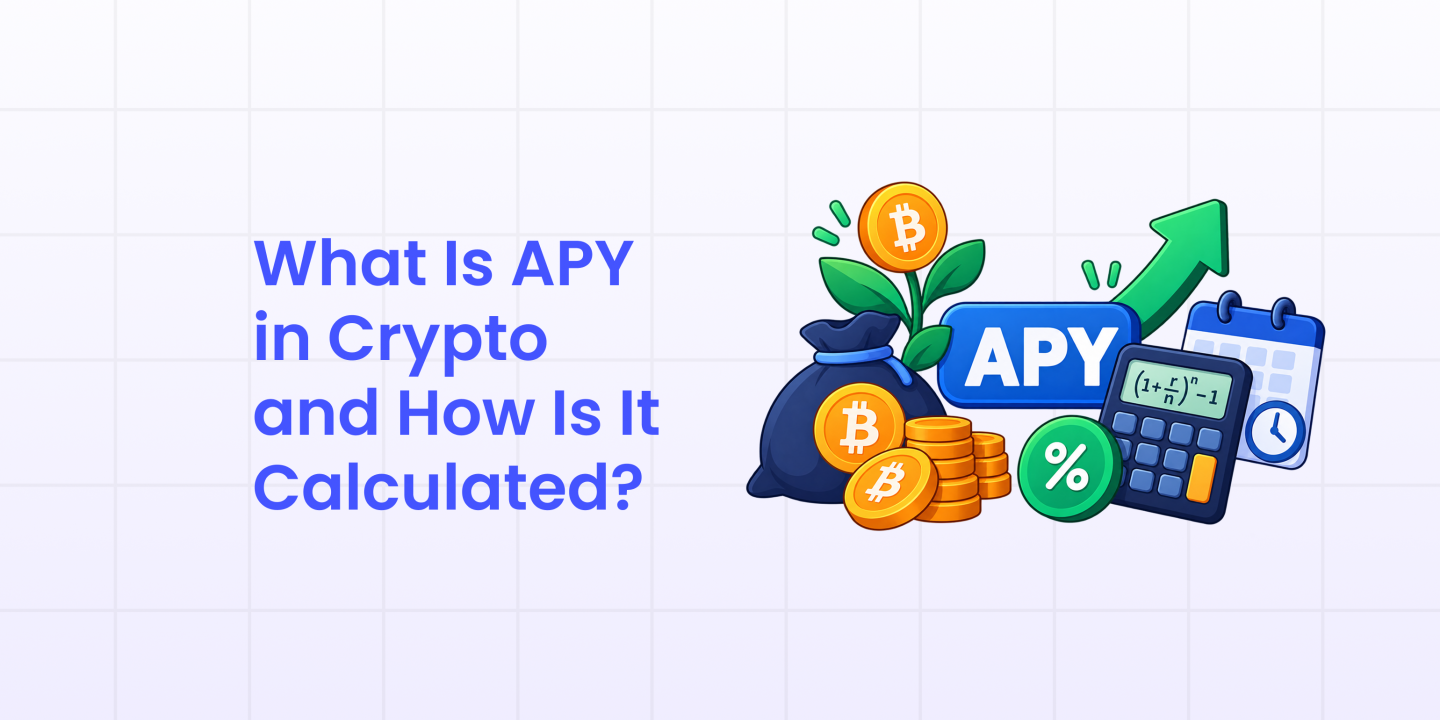
Many new investors frequently ask, “What is APY in crypto?” To keep it simple, it represents the real rate of return earned on an investment over one entire year and is a useful concept to understand for anyone exploring crypto trading for beginners.
What is APY in Crypto?
The acronym itself stands for annual percentage yield in crypto. It builds in the effect of compounding interest, which is what makes the profit estimate accurate. The idea behind compounding is not complicated. Investors earn returns on their starting deposit and on the interest that deposit has already thrown off.
How Does Annual Percentage Yield Work in Crypto?
To fully grasp what APY means in crypto, one must closely examine how digital assets generate passive income. Platforms offer rewards. These incentives are distributed when users agree to lock up their tokens for a designated period. This process allows digital wealth to grow exponentially. Yields fluctuate. When exploring what cryptocurrency is, this metric is vital.
The mechanics of APY in crypto rely on decentralised finance protocols. Decentralised finance operates entirely without central banks. Users deposit digital assets into liquidity pools to facilitate trading. A higher compounding frequency naturally leads to a significantly larger overall return by year’s end. Finding the APY meaning in crypto requires checking the compounding schedule.
Several specific methods exist for generating these returns within the broader digital ecosystem:
- Staking: Investors lock coins to secure a proof-of-stake (consensus mechanism) network.
- Yield farming: Users provide liquidity to exchanges for high fee rewards.
- Lending: Holders lend digital assets to institutional borrowers in exchange for interest payments.
APY vs APR: What’s the Difference?
The primary distinction lies entirely in how they handle the compounding of interest over an extended time. The annual percentage rate only measures the simple interest earned on the base principal amount. It ignores growth. Conversely, the annual percentage yield accounts for the fresh interest earned on previously accumulated interest balances. This difference improves yield calculation.
Factors That Affect APY in Crypto
Various market forces directly influence the returns offered by digital asset platforms. Token inflation rates dictate actual profitability. Extreme price volatility means that projected platform yields can change dramatically overnight without any warning. Supply dynamics matter immensely. They dictate how much interest borrowers are willing to pay at any given moment. Returns stabilise when cautious investors learn what are stablecoins and subsequently provide liquidity with them.
Summary
Grasping these yield metrics empowers investors to make highly informed financial decisions. Passive yield generation is not the only path. Direct trading offers distinct advantages. Those seeking the best Indian cryptocurrency exchange platform frequently turn to Pi42. Pi42 proudly stands as India’s first crypto-INR perpetual futures trading platform. It offers an innovative environment.
Users benefit from a zero-one per cent Tax Deducted at Source (TDS). It gets better. Traders avoid the heavy 30 per cent Virtual Digital Asset (VDA) taxes. The platform even allows for the legal set-off of sustained losses.
FAQs
1. Is a higher APY always better in crypto?
Not necessarily. A higher APY may come with greater risks, such as token price volatility, smart contract vulnerabilities, or lower liquidity. Investors should evaluate both the potential returns and the associated risks before committing their assets.
2. How often is APY updated on crypto platforms?
APY can change frequently depending on market demand, liquidity, staking rewards, and lending activity. Some platforms update their APY daily, while others adjust it periodically based on network conditions.
3. Can APY become negative in crypto?
APY itself is usually displayed as a positive projected return. However, if the value of the underlying cryptocurrency drops significantly, an investor’s overall investment may still incur a loss despite earning rewards.
4. Which crypto assets typically offer APY rewards?
Many proof-of-stake cryptocurrencies, stablecoins, and tokens used in lending or liquidity pools can generate APY. The available yield depends on the platform and the specific asset being used.
5. What should investors consider before choosing a crypto APY opportunity?
Investors should compare the APY, lock-in period, platform security, withdrawal conditions, token volatility, and potential risks before selecting an investment opportunity.
6. Is APY guaranteed in cryptocurrency investments?
No. Most crypto APYs are variable and may change based on market conditions, protocol updates, and user participation. Actual returns can differ from the advertised yield over time.

- Big Loot September: Trade & Win a BMW Bike 🏍️
 Big Loot September is Pi42’s biggest reward drop of the… Read more: Big Loot September: Trade & Win a BMW Bike 🏍️
 - Pi42 Week of Wins: Trade & Win a New iPhone This September
 Pi42 Week of Wins is a September contest where every… Read more: Pi42 Week of Wins: Trade & Win a New iPhone This September
 - Chandi Utsav: Refer and Win Silver Coin
 This September, turn your referrals into something worth its weight!… Read more: Chandi Utsav: Refer and Win Silver Coin
 - Booked by Pi42: Amsterdam Awaits — Trade More, Travel More ✈️
 Booked by Pi42 is a trading contest that could send… Read more: Booked by Pi42: Amsterdam Awaits — Trade More, Travel More ✈️
 - Pi42 Bandhan Bonus: Win Amazon Gift Vouchers This Rakhi
 Pi42 Bandhan Bonus is a Rakhi referral contest where you… Read more: Pi42 Bandhan Bonus: Win Amazon Gift Vouchers This Rakhi